In engineering, there is the concept of noise. This is generally considered to be any unwanted signal in a source and can create huge issues in many areas by masking the desired information. In clinical practice, this noise problem is seen whenever patients are telling us lots of information but not necessarily the things we need to hear and also when we are trying to promote our practices to the wider public.
In statistics, there is a concept known as the long tail, relating to the distribution of certain events (fig 1)
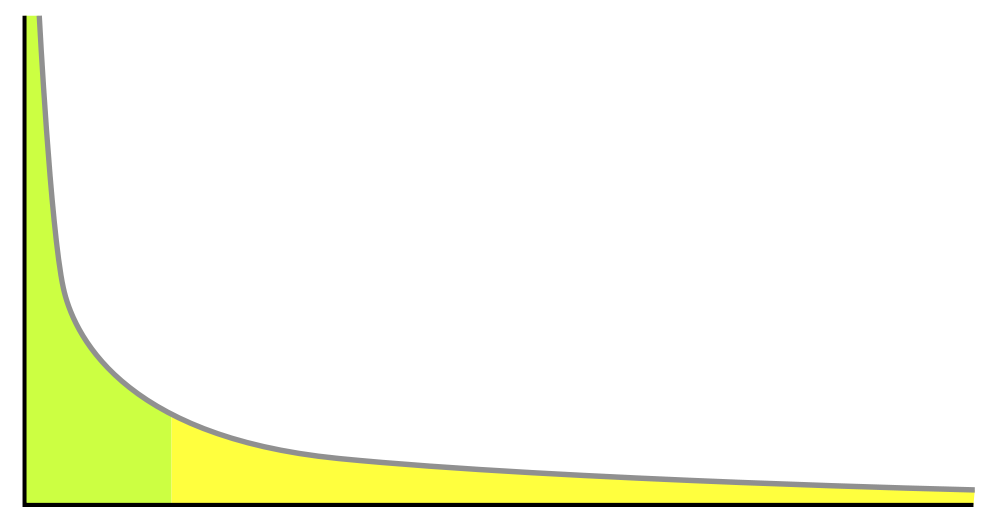
Fig 1: A Long tail curve
(Source Wikipedia; “Long tail” by User:Husky – Own work. Licensed under Public Domain via Commons – https://commons.wikimedia.org/wiki/File:Long_tail.svg#/media/File:Long_tail.svg)
In our case, we could say that the Y axis represents public visibility and the number of practitioners on the X. As can be easily seen, a few practitioners are highly visible and could therefore be considered well known. The rest are all at about the same level. If we applied our Pareto concepts to this, the curves fit and 20% of the people have 80% of the visibility. Great news for them, not so for the rest of us.
How do we go about moving from the unseen to seen? By creating more awareness? This is where the noise problem kicks in. If we are all shouting louder to attract attention, the noise floor just raises, burying the wanted signal in the unwanted clutter. Noise is, as stated, any unwanted signal on a specific channel. Most people have fallen for the myth that communicating via social media is the way to go, to collect followers and post lots of fun things to them. However, time the posts wrongly, include things that people don’t want to hear and you become noise, another missed or irritating signal. So you can either get around this by turning the signal up, posting more often, collecting more followers, likes etc and hope it has the desired effect or you can change tack.
If we were to use a mobile comms approach, the shout louder approach is a 2G, old generation one. If you can’t get above the noise on your chosen frequency band, use a bigger amplifier. With more modern techniques, including wifi and 3/4G mobiles, we use a process known as spread spectrum. This takes the signal we want to transmit and spreads it out across the transmission medium, allowing it to avoid noise, jamming and requiring less overall transmission power. It requires sychnronisation between receiver and transmitter, a process that is handled and agreed at initial set up.
Applying this to a clinical field, if we want to communicate with our current or potential client base, we need to communicate over several different frequency bands, at a known rate and with information that is valid to them. For example there is no point having an active Facebook page if your clients are over 50, never use social media and are very local to you. Instead, we need to use the current base as hopping amplifiers, taking our signal and passing it on. This also allows us to use the trust generation, where one person implicitly trusts a connection, since their friend does. This can require both a driven and request based protocol, where we either ask the person to refer us or produce something that they will want to pass on, spreading our message.
How does all of this relate to the long tail? Without a well structured communication and client generation plan, we are within that tail, an issue also connecting to income. The 20% that might be getting the visibility may also be the ones getting the patients / income. In the creative industries, there are a couple of thinkers who talk about true fans. A true fan is one who buys all of the paintings a particular person makes, goes to see their shows, tells their friends and so forth. With a comparatively limited number of true fans, the artist can make a living, the number required varying with the art form (a musician may need far more than a painter as their average unit price would be lower). We too need fans, people who not only amplify our signal but who can provide us with some form of regular and steady income. Once you sit down and figure out how many you need, you can develop your strategy from there, so that your message is spread correctly, focused and not considered noise.
You don’t need to lift yourself up above the noise floor, just make sure your signal gets received by those who should see it.
 The Camford Clinic
