The basics are the basics

Want to live longer, feel healthier and move better?

Don’t drink alcohol. Cutting down works for some people but most still have too much. Save it for a celebration only.

Don’t smoke.

Walk, do mobility and breath work every day.

Do high intensity, short duration weight training 3 days a week.

Reduce personal inflammatory triggers as much as possible (personal inflammatory triggers can often be dietary, and figuring them out takes a little bit of perseverance and time).

Do everything you can to avoid diabetes. The knock on effects are global (pick an organ and its effected), the medications have side effects and you will die earlier.

So simple to say, a life long process to do.

The 3 supplements your doctor wants you to know about!

We’ve all seen the adverts and articles designed to hook you in and get you reading, exploiting the human trait of wanting to know and hating the idea of missing out.

Perhaps you even read that as 3 supplements that your doctor doesn’t want you to know about.

In this case, they really do want you to know. These can save your life if you need them, and all it takes is a blood test.

Vitamin D

This is a pre-hormone, one of a group of chemicals called secosteroids that has a huge range of effects on the body. In general, the best form is that made by the skin due to sun exposure but from October to March in the U.K., the UV in sunlight is inadequate and we therefore do not produce enough. Add in cultural and personal modes of dress, indoor work and poor diet and there is a risk of deficiency. If you suffer from increased fatigue in the winter (SAD), a family history of bone problems or darker skin, then a quick blood test at the GP can check for vitamin D levels. Current target levels are between 50ng/L and 75ng/L depending on your local health authorities.

Vitamin B12 / Folic acid

Again, these serve multiple purposes in the body, from the formation of neural tubes in a foetus and nerve conductions generally, to the creation of red blood cells. If you’re feeling under the weather and have a low nutrient dense diet, then, again, a quick blood test can help have a look at this potentially silent sign. If you are low, then they can be brought into line quickly with injections, or high dose supplements, especially B12.

All other supplements are for personal preference. I like adding magnesium and probiotics but these are for researched and otherwise investigated conditions, with medical approval.

As with all things, always seek medical advice before changing or starting a plan.

Humans – viral story transporters

We live through stories. We share them, learn from them and pass them on to others.

Health and medicine are just the same as any other area and the stories we tell can kill or cure. Once humans were recognisably human, and language had formed, the stories began. This plant hurts, this plant makes you feel better. Don’t eat that without preparing it this way.

Relationships within the stories developed, changed. If you have this complaint, this plant will help, these symptoms can often be caused by that berry. With that knoweldge came specialisation, the selection of people to carry the story on, to learn and use its power. The medicine man, the hedgewitch.

The very messy practicalities of medicine called for many different people to carry out other roles, barber surgeons becoming surgeons, village grandmothers to midwives, story tellers and escorts in and out of life.

Now, we still have those stories but the specialisation has become even finer. If a person comes to you with low temperature, risk of infection, a high pulse and high breathing rate, they might have sepsis. If another person comes to you with a cough that makes them gasp, but only comes on with exercise, they might have asthma. We trust the knowledge held in these stories to doctors, to people who dedicate their working lives to learning and passing on the stories.

Therefore look around you at what you do, how you share with the people you connect with. Could you tell better stories, share your knowledge in better ways?

Find the key to the story and watch it spread better. Don’t be scared of losing it, it’s never been yours anyway.

On the edges of life.

The beginning is noise. For most, a bright shining explosion into the universe teeming with possibilites.

The end is silence. Hands folded, eyes closed, the machine winding down, no longer animated, to become memories, stories and faded photographs.

Birth is the opening of a book, death is the pen put down at the end of the last paragraph.

Whatever the path underfoot, there is only one way. Forwards.

Sieze that chance, and burn with the brightness of a star.

We know not when the tap will come,  the cover closed, the sand run out.

So prepare to die, mentally and physically. Have your house in order as much as you can, have words said or written that need to be.

And then live the heck out of that gift. Far too many were taken early, some sacrificed on another’s altar, some by their own choice, yet more by cold fate. You are still alive to read this, you still have that opportunity.

Look after the body you were given. Take every opportunity to be stronger, faster, to learn, to share, to be more human.

And be kind.


The long tail problem and noise floors in clinical practice

In engineering, there is the concept of noise. This is generally considered to be any unwanted signal in a source and can create huge issues in many areas by masking the desired information. In clinical practice, this noise problem is seen whenever patients are telling us lots of information but not necessarily the things we need to hear and also when we are trying to promote our practices to the wider public.

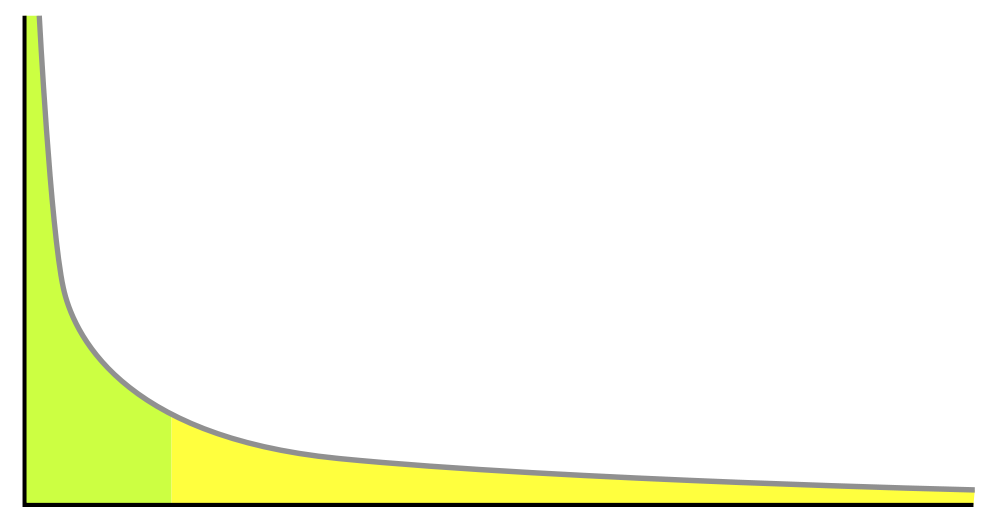
In statistics, there is a concept known as the long tail, relating to the distribution of certain events (fig 1)

Fig 1: A Long tail curve

(Source Wikipedia; “Long tail” by User:Husky – Own work. Licensed under Public Domain via Commons – https://commons.wikimedia.org/wiki/File:Long_tail.svg#/media/File:Long_tail.svg)

In our case, we could say that the Y axis represents public visibility and the number of practitioners on the X. As can be easily seen, a few practitioners are highly visible and could therefore be considered well known. The rest are all at about the same level. If we applied our Pareto concepts to this, the curves fit and 20% of the people have 80% of the visibility. Great news for them, not so for the rest of us.

How do we go about moving from the unseen to seen? By creating more awareness? This is where the noise problem kicks in. If we are all shouting louder to attract attention, the noise floor just raises, burying the wanted signal in the unwanted clutter. Noise is, as stated, any unwanted signal on a specific channel. Most people have fallen for the myth that communicating via social media is the way to go, to collect followers and post lots of fun things to them. However, time the posts wrongly, include things that people don’t want to hear and you become noise, another missed or irritating signal. So you can either get around this by turning the signal up, posting more often, collecting more followers, likes etc and hope it has the desired effect or you can change tack.

If we were to use a mobile comms approach, the shout louder approach is a 2G, old generation one. If you can’t get above the noise on your chosen frequency band, use a bigger amplifier. With more modern techniques, including wifi and 3/4G mobiles, we use a process known as spread spectrum. This takes the signal we want to transmit and spreads it out across the transmission medium, allowing it to avoid noise, jamming and requiring less overall transmission power. It requires sychnronisation between receiver and transmitter, a process that is handled and agreed at initial set up.

Applying this to a clinical field, if we want to communicate with our current or potential client base, we need to communicate over several different frequency bands, at a known rate and with information that is valid to them. For example there is no point having an active Facebook page if your clients are over 50, never use social media and are very local to you. Instead, we need to use the current base as hopping amplifiers, taking our signal and passing it on. This also allows us to use the trust generation, where one person implicitly trusts a connection, since their friend does. This can require both a driven and request based protocol, where we either ask the person to refer us or produce something that they will want to pass on, spreading our message.

How does all of this relate to the long tail? Without a well structured communication and client generation plan, we are within that tail, an issue also connecting to income. The 20% that might be getting the visibility may also be the ones getting the patients / income. In the creative industries, there are a couple of thinkers who talk about true fans. A true fan is one who buys all of the paintings a particular person makes, goes to see their shows, tells their friends and so forth. With a comparatively limited number of true fans, the artist can make a living, the number required varying with the art form (a musician may need far more than a painter as their average unit price would be lower). We too need fans, people who not only amplify our signal but who can provide us with some form of regular and steady income. Once you sit down and figure out how many you need, you can develop your strategy from there, so that your message is spread correctly, focused and not considered noise.

You don’t need to lift yourself up above the noise floor, just make sure your signal gets received by those who should see it.

Simple is not the same as easy.

The second law of thermodynamics states that everything will get more chaotic without input.

This is universal.

If you don’t sort out the little problems, they become big.

If you want to achieve a specific goal, it will take time, energy and focus. Whatever the marketers and internet gurus say, there are no shortcuts. This is simple. It is not the same as easy to accomplish.

Let us help you get better by sorting out the little problems early. One osteopathic treatment ahead of time can save lots of time, money and injury by catching things before chaos catches you.

One day. 

One day you may need to run. Not in your trainers, Lycra and fitted top. Not after a good warm up, chatting with your friends and on a sunny day. 

It will be when you are least prepared. 

Maybe it’ll be raining. Or after a long day. When you’re wearing a smart suit or carrying a shopping bag. 

It might be for a bus, or to stop a child running into traffic, or to escape danger. It will be a sprint from the start, and unrelenting. 

Practice. 

Get a pair of boots, sweatshirt and pair of old trousers. 

Find a hill. Or a field. 

Take the luxury of a warm up. 

Then sprint. 

Try to hold a hard pace for a minute.

Walk back to the start to recover. 

Do it again. 5 – 10 times. 

It never gets easier. But you are more prepared. 

Shoulder pain – Lat chain

If a patient is presenting with shoulder pain, once you have screened for red flags and visceral referral, we can focus on the mechanical presentations. 

Although we get taught hundreds of techniques for assessing shoulder range and function, in general a gross assessment of all planes will give you sufficient information to begin treatment. 

However, one area we tend to ignore or forget is the connections to the rest of the torso. 

We need to look at fascial chains connecting the anterior shoulder to the chest and abdominal structures and especially the role of the lattismus chain in the stabilisation of both the lumbar spine and the shoulder. 

Referring back to our core principles, we can see that if the pelvis and lumbar spine are dysfunctional then the lat chain and hence the shoulder may be recruited to improve stability. 

Therefore, whenever we see a shoulder issue, it falls on us to check further away which may lead to a more significant improvement than just working locally. 

No easy way

There is no easy way to lose weight. 

Anyone saying otherwise is trying to sell a system. 

It is a challenge between reducing energy intake, maintaining muscle and bone mass, ensuring hormonal levels are stable and slowly allowing fat mass to decrease. 

This is pretty much the only way for fat to shift and stay off. 

The commercial weight loss clubs are brilliant for support and basic nutritional advice but there is little evidence that the points or programmes offer any other benefit over self management in a well educated and motivated individual. 

However you do it, getting your weight down to a healthy point, with a BMI below 25 is probably the single most important thing you can do to improve your health, other than not smoking. 

Training made personal 

No matter how much you wish to make changes, sometimes the internal motivation simply isn’t there. 

Time pressures, knowledge, medical complications all make a difference in getting moving and making changes. 

In these circumstances, it’s a good plan to get a trainer in. 

The issue is how to pick one. 

A few pointers might be the following:

Do they look like they walk the talk?

Are they qualified and take regular courses to keep learning?

Are the regimes they’re recommending suitable for you?

Are they working from a big gym, a crossfit box or visiting home? Each has its own philosophy which you might love or hate. 

Can they give you references from successful clients who aren’t mates? 

Most will also give a trial session of two so you can experience their methodology. 

In the end, go by gut and get after it.