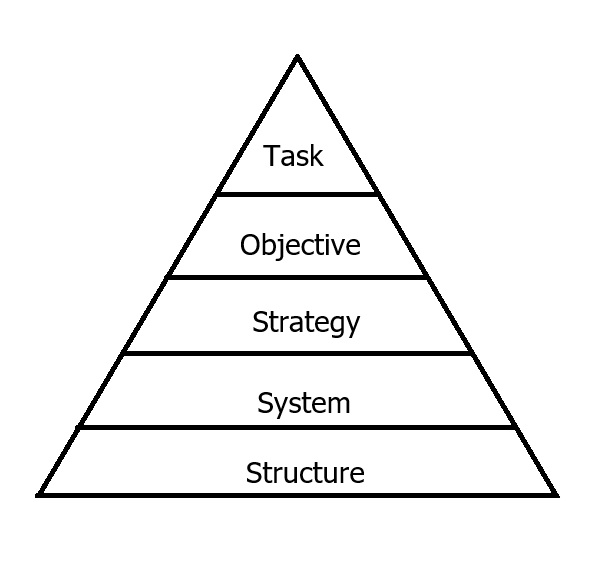
Structure – Strategy – Task

If I see an online coach telling me that their “system” will lean me out, get me faster, improve my strength, I lose interest.

I don’t believe you can have a system without the structure that underpins it or the strategy to implement it. Maybe this is just a linguistic thing and they really mean structure but for me:

Structure: The building blocks. Recovery, Nutrition, Movement, Load, Anatomy, Physiology. The real, tangible elements that make up a human and their environment. Without all the structures in place, you don’t have a solid foundation.

System: Using the elements of the structure together to achieve your strategy. The interfacing layer.

Strategy: Developing the way of using the system to achieve the objective

Objective: What you want to achieve.

Task: A sub unit of the objective that contributes to the forward progress.

So if we are looking to rehab an athlete back from injury, we need to ensure that the structure of their rehabilitation is in place before we start working on the strategies to get them there.

Similarly, weight loss, the great target of the moment. There is no point selling system that will get your clients to achieve great heights if they don’t have the structure in place to allow them to deal with the stress caused by your strategy.

So have a look at the whiteboard. Work out where you are, and how you can support your clients. Do they need you to provide a structure or are they after your expertise for the strategy? Its a partnership.
On: Tendons and Ligaments

Tendons tether muscle, ligaments link bone.

But both can be damaged, become weakened, or scarred.

So how can we, both as practitioners and people, prevent this, or at least minimise its impact?

Prevention is always better than a cure, and therefore ensuring the tendons (when reading tendons, assume ligaments as well, although there are differences in all sorts of subtle ways) remain strong is vital.

Note – If you are currently taking medications, especially certain antibiotics, check with the pharmacy regarding soft tissue effects. For example, Fluoroquinolone antibiotics have a rare side effect with regards to soft tissue, so if you are prescribed those, it may be sensible to reduce training load during and after the treatment.

Tendons can be trained, like any other tissue, and research indicates that they respond best to cycles of isometric tension, of approx 10 – 30 seconds, with 30 – 50 seconds rest. Initially, it doesn’t even matter what joint position you are in, as long as the tendon is under tension, and pain free. Over time, you can increase the load and the number of cycles you carry out, to ensure continued development.

There is also some evidence that longditudinal supplementation with collagen (preferably from biologically similar connective tissue) is beneficial, especially when consumed with vitamin C.

Once you have a stable, platform, you can work on repairing any scarring or weaknesses in the tissue by using long duration concentric / isometric / eccentric training movements, through the pain free range of motion. For example, a squat under light load, with all three phases taking 10 seconds, although this time is individual.

Finally, there is also some evidence that early, and safe return to loading after injury can help reduce the time to competition, since the stimulus causes the scar tissue to form beneficially, rather than scattered.

TLDR: tendons can be strengthed, healthy tendons can increase your overall performance, isometric exercises are beneficial to tendon health.

On: Obesity

We all know what obesity looks like. Too many ‘spoons pie and pint nights, too many burgers, not enough gym time.

Except, we don’t.

It might be visually obvious if the T shirt barely covers the waistline, but how do you define it? If you use the BMI scale (weight in kilos divided by height in metres squared), then obesity is considered anything over a BMI of 30, overweight is over 25, healthy is 20-25 and so forth.

But then a lot of athletes, especially power althletes, are obese. Of course, the more mass you have to move around, the greater the load your body has to manage, both for joint health and cardiovascular load but this doesn’t take into consideration the positive effect of muscle mass, cardiovascular fitness, and any other number of markers for health. The only use for BMI in most aspects is to tell you what you already know, when its far too low or far too high. For reference, you probably don’t want to be below 20 (not enough muscle mass) and above 30 (increased risk of joint issues).

A preferred methodology, for a rapid ready reckoner, is height to waist ratio. This ignores mass, but can idicate central obesity, which has been shown to have a detrimental effect on internal organs and general health. This is simply calculated as a ratio of height to waist circumference (waist divided by height in m), and should be less than 0.5.

As for markers of fitness, define your own. Markers such as the amount you can lift, or how fast you can run, are spurious goal setting. And no matter what the companies might say, you can’t tell your fitness from blood tests. Those are for if you are sick. Otherwise the levels will constantly fluctuate and tell you very little.

Be able to run, if you have the physical capability. Then try to increase the distance you can cover. Lift heavy things safely, then do it again. Move regularly, as smoothly and freely as possible. Constantly develop your capacity.

Train as though your life depends on it.

It does.

On: Fitness

A colleague had started going to the gym “to get fitter”. While admirable and absolutely to be celebrated, I did wonder how they would know when they had achieved that goal.

After some reflection, and a walk, I developed the thought that fitness can be broken down into 2 main components. A duration / distance one, and a strength / durability one.

Duration / distance is comparatively simple. Can the person go further, for longer, or faster. These are goals that can be defined, measured and checked. Walk for a mile, walk for an hour, finish a 5k event, run a marathon, cycle for 3 hours, push the wheelchair to the shops.

The other component is harder to measure. Yes, strength can be measured by increasing the amount you can move against resistance and for how long. But that doesn’t tend to serve an end purpose. I would posit that the role of strength for the vast majority of people, athletes included, is to help them carry out a defined task with more capacity, to be more durable and to recover faster. In Crossfit this may be to complete the prescribed workout faster, or with less fatigue. For others, it may be to be able to carry a child, lift down a suitcase or spend longer with their family before tiring. And for all, it should help reduce the risk of injury.

By redefining our initial goal of fitness, we can review the strength component in this capacity and then prescribe the correct stimulus to get the desired response.

Instead of saying you want to get fitter, define a goal, and a measurable, meaningful outcome. Then tune the exercise to that.

Flow and glide

To move smoothly, all your tissues need to flow and glide. If they cannot, or do not, then the body will attempt to compromise. And eventually, it can fail. This leads to restriction, pain and immobility. Which can of course create a viscious circle of reduced ability.

What can cause changes in the glide? Joints we all sort of understand. Pain, swelling, inflammation and instability will lead to changes around that joint. But the soft tissues can also experiene those, leading to a conceptual stickiness, where tissues simply don’t want to move over each other smoothly. Some stickiness can be temporary, some can be more permanent (scarring), but stickiness within the system can lead to drag on the tensegrity, reducing the adaption capabilities. This is why you can see limitations in the shoulder and find the solution in the ankle, why mobility exercises that improve tissue range of motion can reduce pain globally, and why it is sometimes so hard to achieve complete resolution in a presentation. You haven’t dealt with the underlying lesion.

The thing is, trying to get your head around this is only the first element of treatment. and it can be particularly difficult, to detach from the description and go looking, or listening, to where another problem lies.

Treat close, check the chain, look at the centre, improve the chain, repeat.

On: Simple

Simple is not the same as easy.

In fact, most of us complicate things, because simple is hard work.

If you look at the goals most of us want to achieve, they seem simple, yet we fail so often. Partly through our own weakness, partly through temptation, and mostly because the simple route is the hardest.

Want to get stronger, slimmer, richer, have better relationships? Good. Admirable goals. Now go work at them.

Stronger? Train, not just exercise. Sacrifice something important to get there.

Slimmer? Be careful what you wish for, lets change that to optimise your metabolic health. Now don’t have the take away and exercise regularly.

Richer? Spend less than you earn, clear up your debt burden and be creative with investing.

Better relationships? They take a lot of work, mostly on yourself.

All simple goals, all challenging and resource consuming.

And seek support. We can’t help with the financial or relationship goals, although being healthier and more resilient can have huge positive benefits in all aspects of your life, but we can support you with getting stronger, healthier and more resilient.

Contact us and see how we can help you upgrade.

On: Dosing

On: Dosing.

The dose is important. If you take too little of a medicine, it is ineffective. If you take too much it will kill you.

The same stands for training, or almost any action. Too little and you will experience no benefit, too much and you will burn out. Of course, this effect tends to be cumulative, and with training, too much may not be immediately obvious.

Which is why finding your baseline, and seeking professional input is vital, particularly when starting out or attempting a specific goal.

Once you’ve set a goal, seek an expert to tune it and succeed.

On: Training

You’ve been in the gym, in the pool, or on the road. You’re turning up, putting in the hours. And yet, you’re not improving. The weight isn’t shifting, the personal bests are not rolling in, the same old faces as the same competitions still shake your hand, the race finish time is about the same as last year. You can’t actually do more miles, or lift more weight, as other commitments would suffer, and you’re on the cusp of overtraining.

Frustration abounds.

But…. are you training or exercising? We can too often convince ourselves that we are training, simply because we are going through the motions and turning up. The difference? Exercise is exertion, training is progressive overload with rest and retesting points. Fitness posers exercise, gym bros exercise, older people in village halls exercise. Exercise is good, its vital to positive health, but past a certain point it won’t necessarily lead to the changes you’re wanting.

However.

Perhaps there is another way.

Take a break. A few days off, or if that sucks mentally, a few easy days. During that time, define some baseline movements that matter to your discipline. A defined distance for running, swimming or cycling. A set of lifts that matter, a benchmark workout.

Then go for it. Have a test week. If you can’t measure it, you can’t manage it, and if you can’t manage it, you can’t improve it.

See how good you are, push it and draw a line in the sand. Go far, go fast, go heavy.

Take the results, sit down, with an expert if you can, or yourself and a pad if you have a good training knowledge.

You can always get stronger, improve mobility, hone skill, but then look honestly at what you’re good at, what you need to improve, then broaden the scope. Actively look for the weaknesses. Can you improve your nutritional base line, your sleep, your recovery?

Write a plan, stick to it, record, then in 6 weeks, do it again.

You will get better.

Maybe, finally, your power to weight ratio will improve, your 5K time will crack the that precious mark, your bear complex will get better.

Test, reflect, plan, execute.

If you find mobility is an issue, an injury doesn’t respond to rest, you want some nutritional guidance, or another expert opinion, then come see us. With over 20 years therapeutic experience, 30 years of practical involvement in sport, and a unique perspective on life, we may be able to help.

Onwards.


On: Beyond movement

There are the eight prescribed movement patterns: flex, extend, rotate, push, pull, squat, lunge, walk.

But beyond that is the ability to do them smoothly and under load.

For example, when out walking, without losing step, run your fingers along the ground. That involves walking, flexing, lunging and an element of rotation.

Now repeat the action raising your hand over head to touch a tree leaf. Again, walking, extending, rotation.

The more complex the move, the more we challenge our neuromuscular system, the less spare capacity we have and greater the risk of subtle injury due to compromise.

Therefore, we should train these elements. Not just the standard gymrat moves, but through play.

Look at an object and play with it. A plate carried overhead. A tree branch that can be climbed on or over, or under. A line on the pavement to walk along, skip over, or walk backwards over.

Look at the environment as a playground, and use it to improve the way you move.

Injury proof yourself through play.

On: Delayed Gratification

There is a relatively well known psychological study where the experimenters place a marshmallow, or other tempting treat, on a plate in front of a child.They then leave the room, promising that, if that item is still there when they return, the child can have more of them. Of course, many of the children cannot resist the sweet and will consume it immediately. Others find ways to distract themselves until the adult returns.

What is particularly interesting is that those who are able to delay gratification and not eat the sweet tend to do better in other areas of life as they grow and develop, as though this skill is transferable.

Almost everyone struggles with weight loss. We all know the benefits of optimising our weight for health, but the reality is that the process is incredibly challenging. At least with a marshmallow you get 2 when the tester returns, in weight loss you simply don’t get negative things a long way down the line. Frankly, its is the ultimate delayed gratification, if we ignore the Abrahmic concepts of Heaven. The true payoff comes at the end of a life hopefully well lived, when you perhaps get to enjoy a longer healthspan.

Assuming that the rest of the body’s homeostatic mechanisms (hormonal balance, neurochemistry, renal function, cardiac function etc) are correct, then for all the diet tea adverts and weight loss pills, weight management really is an energy management equation with no shortcuts. Precisely how that energy is composed and therefore how your body uses it is another matter, but for the purposes of most people’s understanding, if you consume more than you require, if goes in the baggage and you end up carrying it around, leading to pain, dysfunction, and increased risk of disease and early death.

However, don’t eat that nice pizza / pasta / curry / noodle bowl or we may have to chop your leg off in 20 years time doesn’t ring true with the hungry monkey deep inside who thinks that tomorrow might not come either, food is scarce and resources need to be hoarded. We struggle to make the long term interventions that will make a difference because the pay off simply doesn’t exist on most people’s radar.

To manage the monkey, we need to work with it, not try to beat it. Eat a little less (especially energy dense, processed foods) move a little more, use resistance training to optimise muscle mass and reward yourself for the small wins. Just don’t obsess over the scales and remember there are no cheat days.