You are what you do.

They presented with a long history of shoulder and back pain, with occasional headaches, particularly in the evening. No other significant complaints, simply a tight and painful upper back, and shoulders, with a stiff neck.

After taking a thorough history and checking pertinent red flags, I carried out a suitable examination, looking at how they used their body, how it wanted to respond passively and actively.

And the thing was, other than the presenting complaint, there wasn’t much to be found. An anteriorised head posture and slightly kyphotic thoracic spine, but nothing much more than you might expect for a modern lifestyle. They exercised frequently, were not obese and tried to optimise their working posture when at a desk.

I treated what I found, and we addressed a few issues, but I was unhappy with their progress, as the complaint didn’t feel like it was resolving along the curve I expected.

Then it clicked. Whenever I went through to reception to collect them, they were playing with their phone. Head slumped forwards on the chest, looking down at the tiny screen and typing or scrolling away.

The problem is, modern expectations are that we are constantly connected, with rewards and punishments meted out by both the device and other people if we do not respond to its electronic siren call. I am as guilty as the next person, at instinctively checking and wasting hours.

It was this small, but frequent behaviour that was causing, in this case, the shoulder pain. Looking down was loading the back of their neck, the shoulders were coming in to support the arms holding close and everything matched when I mimicked them.

However, other than taking the phone away from them, there wasn’t a direct intervention I could do, so instead we discussed possible mitigation strategies, to reduce the automatic reaction, shorten the time spent interacting and change the posture, things that have been shown to work.

Following the rules of three, I suggested:

  • Switching on greyscale. This, interestingly, makes the device far less stimulating, but still allows you to work effectively. It also helps increase battery life on some devices.
  • Clean up the home screen and put apps that distract in a folder so you don’t see them first
  • Turn off notifications for social media applications

The point was simply to create a brain pause that allowed for a moment more reflection before the action, rather than create a wholesale change that would more likely fail.

Having created this awareness and put in some simple measures, we were both very happy to see that the treatment was then far more effective and the presenting issues resolved.

After they had left, I reflected in how the simple actions we do can have profound impacts and that, as practitioners of every discipline, we need to continue to look at the whole person, not just the complaint.

A reflection on training planning

When thinking about training planning, whether for personal development or competition, there are a number of variables we all need to consider, whether as the trainer or trainee.

Underlying it all and before we can even start planning, we need to work out where the following are:

  • Intention
  • Attention
  • Focus

Both for the immediate goal and the longer term structure. Once these have been identified, and there can be only one or two main intention points, then the next step can be assessed.

Here, we need to look at which phase of training we are in. If we are a beginner, or have been training for only a short period of time, then we are still in base development, where we are learning the mechanics and improving work capacity. As we improve, we can start working on the individual elements of our chosen discipline. These can include:

  • Skill
  • Stamina
  • Strength
  • Speed

These lead to a development of work capacity. Or, the ability to do something faster, more accurately and for longer and more efficiently.

When looking at each days training plan, it goes through 4 phases, the length of which dependent on the above goals and the physiological status.

  • Move
  • Groove
  • Load
  • Cruise

We first start to move, to explore the body’s capacity for work that day, consider recovery from the last training session or injury. We then start to groove in the movements that we will be training that day. Once warm and ready, we can finally get the load moving, whether that is under a barbell, a HIT phase or a bike ride. Once we have completed the scheduled work, we finally cruise down, checking in again to note how we went, and to feedback for the next session.

The final, often overlooked and probably as important element of training is the recovery and nutrition. However, we tend to look at the work rather than the recovery, believing that more is better, which for most people, it tends to be, given the rest of their lifestyles, but with that, the nutrition element still has to be considered, and for most people, should be one of their two main attention points. Nutrition is a huge, complex and troublesome area, can be generally be summed up succinctly as:

“Eat meat and vegetables, nuts and seeds, some fruit, little starch and no sugar. Keep intake to levels that will support exercise but not body fat”

Greg Glassman

Now, forget everything, go and play.

You evolved to run…

It has been said many times before, especially here, that you evolved to run. The combination of an independent respiratory system (via diaphragmatic control), the ability to lose heat via sweat, the nuchal ligament in the neck, large gluteals and an achilles tendon all indicate that we run. There are also evolutionary theories that indicate our brains developed to allow us to predict the behaviours of animals we were hunting.

Running also has a fantastic effect on the skeleton, triggering hormones in the long bones that help control appetite (Lipocalin-2), driving osteogenesis (the continued creation of new bone) and preventing degeneration. It even helps neurogenesis, the creation of new brain cells and nerve pathways, by flushing fresh blood through at a much higher rate for longer, as well as suppressing excessive glucose storage by forcing muscles to use it as fuel.

Many people, including respected orthopaedic surgeons, believe that running is not healthy for the joints, and that it will leave to early degeneration. There is some validity to this concern, but with a certain number of caveats. If you have not run for a significant period of time, or are overweight, then you may experience joint pain when you start. Similarly, if you are not biomechanically efficient, then you find it harder work than you expect. Not only that, if you look at indigenous runners, they don’t do it in the same way we consider standard, rather running and walking, depending on the terrain.

However, a number of studies (https://doi.org/10.1002/art.24840, https://link.springer.com/article/10.1007/s00167-013-2686-6) as well as others, show that there is no detrimental impact on the joints, with some evidence that it actually helps strengthen the tissues.

What is the practical upshot of this? If you can, start running. Carefully, steadily and allowing a great deal of time. The upside far outweighs the downs. If you can’t, cycle or walk.

If you want to start running, do so slowly. Follow the NHS couch to 5k program. Given that any weight over your theoretical optimal (BMI of 23 – 27 depending on muscle mass) is increased load on the joints, limit your long runs to reduce the chance of injury while you work on the weight. And, as you approach a maintainable weight, you will experience the benefits far more than the lows.

If you can’t run, do something that mimics the cardiovascular and skeletal load. Lift weights, row, walk at a rate that leaves you sweaty, it all helps.

Beyond 3 basic skills

Previously, the 3 basic movement skills were raised.

These were:

  1. Getting off the floor from lying on your front
  2. Getting off the floor from lying on your back
  3. Walking at least a mile carrying a load

These use the primal movement patterns and the vast majority of us have been able to do them since the age of 2.

We can therefore advance these and actually start to develop them as a physical practice to improve our health, with very little other equipment.

If you have not exercised for a while, or have pre-existing medical conditions, please do consult your GP or practice nurse for a health check before starting any program.

As a test day, start by going for a brisk walk, sufficient to get you slightly breathless after 10 minutes, then aim for a mile, or 20 minutes. Once in a safe place and once you are warm, get on the ground. First, from your front, get up. Then from your back.

If that was challenging, or you struggled to get up, your first month would be simply practicing until you can do 10 from both front and back.

Once you can do that, you can add some more load.

With nothing more than a couple of bin liners, a reel of strong tape, an old rucksack and a bag of builder’s ballast (sand / gravel mix), you can create all you need for a very effective workout.

Fill a bin liner with a few kilos of the ballast. Tape it into a strong, short sausage shape and place this in another bag for safety. Create a few of these, of differing weights.

Once you have the weights, put sufficient in your rucksack to equal 5-10 kilos then do a 30 minute walk at a brisk pace.

Once back, adjust the load in the rucksack to about 2-5kg and perform 10 front get ups with the bag on. The, taking a sausage across your shoulder, perform 5 with it on the right before doing 5 on the left. As you get stronger, increase both the load in the rucksack for the walk and the getup challenge.

You should find that that provides a decent workout and can act as a gateway to more training techniques.

5 daily habits, 3 basic skills

There are 5 habits we do every day, and that most of us take for granted. They are the basic skills needed to function well in everyday life, well before the more complex elements of household management and navigation in a modern society come in to play.

Yet when we are unable or unwilling to perform them, it’s time to ask for help from those around us, as they are the foundation stones on which all other skills rest. These are the things that our primary carers would have taught us to do by the time we were ready to leave home and almost all of us will have done today.

  1. Get up and make your bed
  2. Perform a personal hygiene routine and dress appropriately
  3. Prepare and eat a nutritious hot meal
  4. Movement and physical maintenance
  5. Interact socially and do something creative and productive

These can be viewed as a stack, and performing one allows the next to take place more efficiently. The inclusion of creation and productivity in the list, is in my mind, crucial, as it allows us to express an important element of our personality, and its presence or absence is an indicator in our mental, as well as physical health.

The habit most people will tend to misunderstand and misinterpret is that of movement and physical maintenance. Here, there are 3 basic skills that we should be able to perform unless we have a diagnosed impairment. And, as above, the inability to do these indicates that we need to check in with an appropriate professional for support and to allow us to regain them, or plan to mitigate the risk of losing that element of independence. 

  1. Get off the floor from lying on your front
  2. Get off the floor from lying on your back
  3. Walk a mile with a moderately heavy load

These use all the primal movements (push / pull / flex / twist / squat / lunge / walk), as well as the fundamental human expression of gait.

Physical maintenance is the skill of daily self care, being able to mobilise and strengthen the body, with stretching, joint position awareness, breathing exercises and strength training. If starting this practice, after a period of relative immobility, then it is recommended that you start gently, focusing on the ankles, hips and shoulder girdle, with breathing as a guide.

Basic Measurements

There are basic markers we can measure and improve to gauge overall health.

In a hospital or medical environment, we will measure Heart Rate, Respiration Rate, Temperature, Peripheral Oxygen Saturation (SpO2), Blood Pressure and AVPU (the patients level of alertness).

More invasively, we will then take an ECG and VBG / ABG (Venous Blood Gas / Arterial Blood Gas). These allow us to have a good  impression of the current state of your heart and a gross impression of your metabolic processes (glucose, haemoglobin, lactate etc).

With these measures and a good history, we will have a good idea of just how unwell you are and where to start looking for the underlying problem.

If you are unfortunate enough to need admission, part of the nursing process will involve measuring your height and weight. This allows us to calculate the correct drug dose and other supportive measures.

We are also able to calculate your body mass index. This is a commonly used scale, taken from your weight in kilos, divided your height in metres squared. It allows us to quickly see whether you are underweight, average, overweight or obese.

Outside a hospital environment, some of the above measures are often really useful for tracking your personal health, in conjunction with your general practitioner. A low pulse, low blood pressure and stable BMI are all indicators of positive health.

Some people argue that in more athletic individuals, BMI is not a good marker and it may not be very useful in very muscular people. However, it does still indicate how much overall load is being placed on the body, including the heart and the joints.

It can also be argued that, as a healthy adult, until you are able to squat 70-100% of your own body weight, bench press 50-70% of it (dependent on gender), deadlift 120% of your bodyweight, get up from lying on the floor 10 times and walk quickly for at least an hour, with a body fat percentage of between 20 and 25% then you can probably do with losing some fat and improving your global fitness. These are, of course, arbitrary markers for a fully able bodied adult and you may wish to define your own within your own physical boundaries.

Another easy to track health marker is waist to hip ratio. This has been written about before here and is the circumference of your waist, just above the navel, divided by the circumference around your hips. For men, this should be less than 0.9 and for women, less that 0.8. If it were too high then it is indicative of intra abdominal fat, which is known to be unhealthy.

Therefore, I would propose the following as good targets for anyone without underlying known health condition.

A blood pressure of 120-130 / 70

A resting pulse of 50-70bpm

BMI below 25 unless measurably muscular

Waist to Hip ratios appropriate for gender

The above markers for fitness, once warmed up.

If you think that you have a physical restriction holding you back from what you would like to achieve and would like us to support you in improving your health, call and book in for a no obligation chat.

As always, this is not to be taken as legal medical advice and if you have any health concerns, see your registered doctor who will be able to help.


Breathing mechanics and change

When we consider respiration, most of us will think of it as breathing in and out. Those with a science education will then look at the passive gaseous exchange taking place across the membranes within the alveoli and the processes taking place deep in the cells. A medic will be able to look the physiology, the gases themselves and the state of the arterial blood and have a good run at diagnosing many medical conditions. If you are unfortunately hospitalised, 2 of the prime observations we make will be your respiration rate and your oxygen saturation in your blood.

In the end, this means very little but has a huge consequence on our lives. If we cannot breath well, we cannot live well.

Whenever we are challenged or threatened, our breathing will change. If we are shocked or surprised, we will instinctively hold our breath. Fine for a few seconds, less useful when we need a balanced oxygen / carbon dioxide ratio for thought and efficient brain function. So if you are permanently on edge, it may be that you spend most of your time holding your breath, leading the brain to chronically adjust the carbon dioxide / oxygen ratios (measured at the aorta). This breath holding pattern may also lead the brain to consider all things a threat, be that sport, academic or practical.  And, if our respiratory mechanics are dysfunctional, for any number of reasons, then we will not be as efficient as we can or should be, which can also lead to this challenged patterning at a neuromuscular level.

From a practitioners perspective, we need to consider not just the anatomical structures directly involved in respiration, but those tethered and related to it. As an osteopath, respiration is probably the most important system I am able to directly influence. More so than circulation (apologies to A.T Still). The rule of artery is important, but if there is poor gas balance and compromised respiration, then all other systems will be adapting to compensate, assuming blood flow is present at rest.

To me, the respiratory system starts with the nose and the sinuses in the head. It includes the standard elements of trachea, bronchi, lungs and diaphragm, but also needs to include the thoracic and lumbar spine, the ribs and even the hip flexors and all surrounding musculature.

If I can create sufficient change within in any of these elements, then I can create a positive shift in state. If I can change state, I can positively influence the health of the whole body.

Breath better, move better, be better.

Humans – viral story transporters

We live through stories. We share them, learn from them and pass them on to others.

Health and medicine are just the same as any other area and the stories we tell can kill or cure. Once humans were recognisably human, and language had formed, the stories began. This plant hurts, this plant makes you feel better. Don’t eat that without preparing it this way.

Relationships within the stories developed, changed. If you have this complaint, this plant will help, these symptoms can often be caused by that berry. With that knoweldge came specialisation, the selection of people to carry the story on, to learn and use its power. The medicine man, the hedgewitch.

The very messy practicalities of medicine called for many different people to carry out other roles, barber surgeons becoming surgeons, village grandmothers to midwives, story tellers and escorts in and out of life.

Now, we still have those stories but the specialisation has become even finer. If a person comes to you with low temperature, risk of infection, a high pulse and high breathing rate, they might have sepsis. If another person comes to you with a cough that makes them gasp, but only comes on with exercise, they might have asthma. We trust the knowledge held in these stories to doctors, to people who dedicate their working lives to learning and passing on the stories.

Therefore look around you at what you do, how you share with the people you connect with. Could you tell better stories, share your knowledge in better ways?

Find the key to the story and watch it spread better. Don’t be scared of losing it, it’s never been yours anyway.

The long tail problem and noise floors in clinical practice

In engineering, there is the concept of noise. This is generally considered to be any unwanted signal in a source and can create huge issues in many areas by masking the desired information. In clinical practice, this noise problem is seen whenever patients are telling us lots of information but not necessarily the things we need to hear and also when we are trying to promote our practices to the wider public.

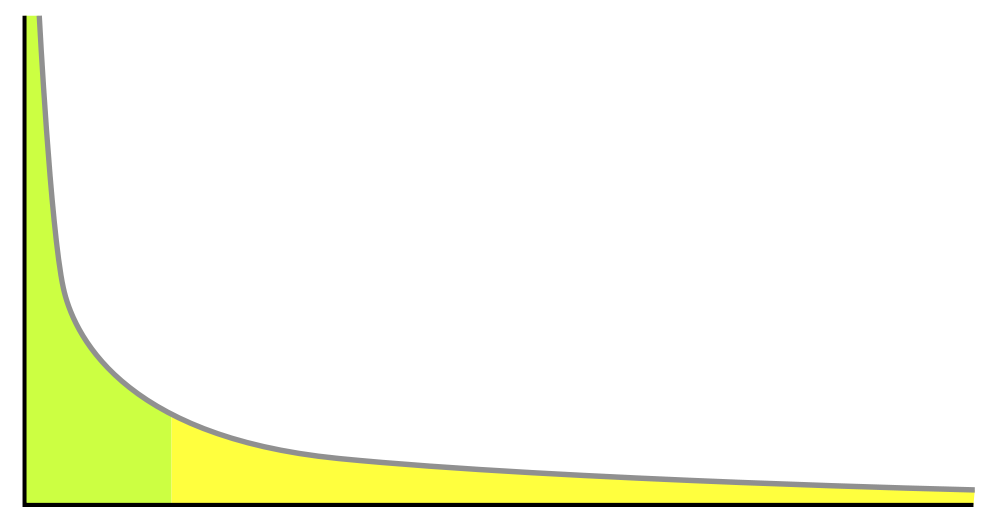
In statistics, there is a concept known as the long tail, relating to the distribution of certain events (fig 1)

Fig 1: A Long tail curve

(Source Wikipedia; “Long tail” by User:Husky – Own work. Licensed under Public Domain via Commons – https://commons.wikimedia.org/wiki/File:Long_tail.svg#/media/File:Long_tail.svg)

In our case, we could say that the Y axis represents public visibility and the number of practitioners on the X. As can be easily seen, a few practitioners are highly visible and could therefore be considered well known. The rest are all at about the same level. If we applied our Pareto concepts to this, the curves fit and 20% of the people have 80% of the visibility. Great news for them, not so for the rest of us.

How do we go about moving from the unseen to seen? By creating more awareness? This is where the noise problem kicks in. If we are all shouting louder to attract attention, the noise floor just raises, burying the wanted signal in the unwanted clutter. Noise is, as stated, any unwanted signal on a specific channel. Most people have fallen for the myth that communicating via social media is the way to go, to collect followers and post lots of fun things to them. However, time the posts wrongly, include things that people don’t want to hear and you become noise, another missed or irritating signal. So you can either get around this by turning the signal up, posting more often, collecting more followers, likes etc and hope it has the desired effect or you can change tack.

If we were to use a mobile comms approach, the shout louder approach is a 2G, old generation one. If you can’t get above the noise on your chosen frequency band, use a bigger amplifier. With more modern techniques, including wifi and 3/4G mobiles, we use a process known as spread spectrum. This takes the signal we want to transmit and spreads it out across the transmission medium, allowing it to avoid noise, jamming and requiring less overall transmission power. It requires sychnronisation between receiver and transmitter, a process that is handled and agreed at initial set up.

Applying this to a clinical field, if we want to communicate with our current or potential client base, we need to communicate over several different frequency bands, at a known rate and with information that is valid to them. For example there is no point having an active Facebook page if your clients are over 50, never use social media and are very local to you. Instead, we need to use the current base as hopping amplifiers, taking our signal and passing it on. This also allows us to use the trust generation, where one person implicitly trusts a connection, since their friend does. This can require both a driven and request based protocol, where we either ask the person to refer us or produce something that they will want to pass on, spreading our message.

How does all of this relate to the long tail? Without a well structured communication and client generation plan, we are within that tail, an issue also connecting to income. The 20% that might be getting the visibility may also be the ones getting the patients / income. In the creative industries, there are a couple of thinkers who talk about true fans. A true fan is one who buys all of the paintings a particular person makes, goes to see their shows, tells their friends and so forth. With a comparatively limited number of true fans, the artist can make a living, the number required varying with the art form (a musician may need far more than a painter as their average unit price would be lower). We too need fans, people who not only amplify our signal but who can provide us with some form of regular and steady income. Once you sit down and figure out how many you need, you can develop your strategy from there, so that your message is spread correctly, focused and not considered noise.

You don’t need to lift yourself up above the noise floor, just make sure your signal gets received by those who should see it.

Simple is not the same as easy.

The second law of thermodynamics states that everything will get more chaotic without input.

This is universal.

If you don’t sort out the little problems, they become big.

If you want to achieve a specific goal, it will take time, energy and focus. Whatever the marketers and internet gurus say, there are no shortcuts. This is simple. It is not the same as easy to accomplish.

Let us help you get better by sorting out the little problems early. One osteopathic treatment ahead of time can save lots of time, money and injury by catching things before chaos catches you.