The long tail problem and noise floors in clinical practice

In engineering, there is the concept of noise. This is generally considered to be any unwanted signal in a source and can create huge issues in many areas by masking the desired information. In clinical practice, this noise problem is seen whenever patients are telling us lots of information but not necessarily the things we need to hear and also when we are trying to promote our practices to the wider public.

In statistics, there is a concept known as the long tail, relating to the distribution of certain events (fig 1)
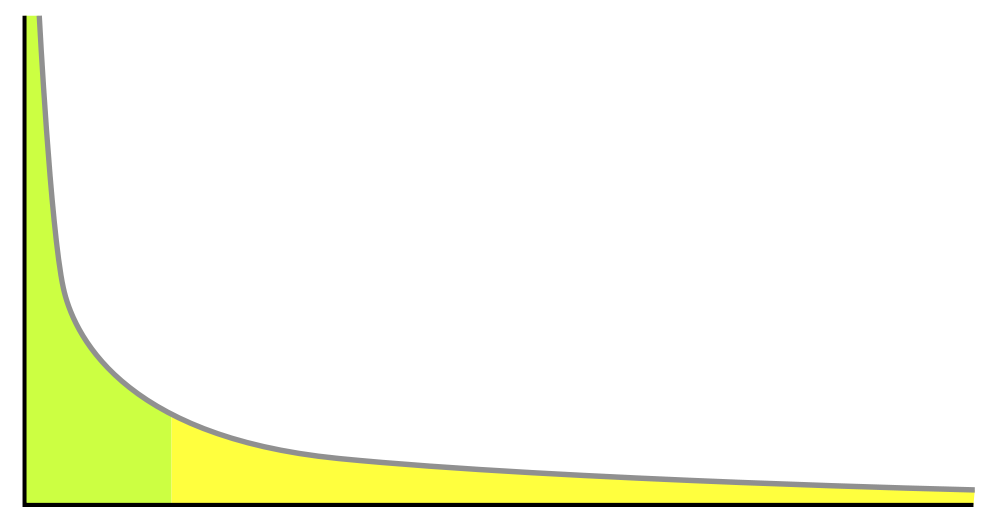
Fig 1: A Long tail curve

(Source Wikipedia; “Long tail” by User:Husky – Own work. Licensed under Public Domain via Commons – https://commons.wikimedia.org/wiki/File:Long_tail.svg#/media/File:Long_tail.svg)

In our case, we could say that the Y axis represents public visibility and the number of practitioners on the X. As can be easily seen, a few practitioners are highly visible and could therefore be considered well known. The rest are all at about the same level. If we applied our Pareto concepts to this, the curves fit and 20% of the people have 80% of the visibility. Great news for them, not so for the rest of us.

How do we go about moving from the unseen to seen? By creating more awareness? This is where the noise problem kicks in. If we are all shouting louder to attract attention, the noise floor just raises, burying the wanted signal in the unwanted clutter. Noise is, as stated, any unwanted signal on a specific channel. Most people have fallen for the myth that communicating via social media is the way to go, to collect followers and post lots of fun things to them. However, time the posts wrongly, include things that people don’t want to hear and you become noise, another missed or irritating signal. So you can either get around this by turning the signal up, posting more often, collecting more followers, likes etc and hope it has the desired effect or you can change tack.

If we were to use a mobile comms approach, the shout louder approach is a 2G, old generation one. If you can’t get above the noise on your chosen frequency band, use a bigger amplifier. With more modern techniques, including wifi and 3/4G mobiles, we use a process known as spread spectrum. This takes the signal we want to transmit and spreads it out across the transmission medium, allowing it to avoid noise, jamming and requiring less overall transmission power. It requires sychnronisation between receiver and transmitter, a process that is handled and agreed at initial set up.

Applying this to a clinical field, if we want to communicate with our current or potential client base, we need to communicate over several different frequency bands, at a known rate and with information that is valid to them. For example there is no point having an active Facebook page if your clients are over 50, never use social media and are very local to you. Instead, we need to use the current base as hopping amplifiers, taking our signal and passing it on. This also allows us to use the trust generation, where one person implicitly trusts a connection, since their friend does. This can require both a driven and request based protocol, where we either ask the person to refer us or produce something that they will want to pass on, spreading our message.

How does all of this relate to the long tail? Without a well structured communication and client generation plan, we are within that tail, an issue also connecting to income. The 20% that might be getting the visibility may also be the ones getting the patients / income. In the creative industries, there are a couple of thinkers who talk about true fans. A true fan is one who buys all of the paintings a particular person makes, goes to see their shows, tells their friends and so forth. With a comparatively limited number of true fans, the artist can make a living, the number required varying with the art form (a musician may need far more than a painter as their average unit price would be lower). We too need fans, people who not only amplify our signal but who can provide us with some form of regular and steady income. Once you sit down and figure out how many you need, you can develop your strategy from there, so that your message is spread correctly, focused and not considered noise.

You don’t need to lift yourself up above the noise floor, just make sure your signal gets received by those who should see it.

Simple is not the same as easy.

The second law of thermodynamics states that everything will get more chaotic without input.

This is universal.

If you don’t sort out the little problems, they become big.

If you want to achieve a specific goal, it will take time, energy and focus. Whatever the marketers and internet gurus say, there are no shortcuts. This is simple. It is not the same as easy to accomplish.

Let us help you get better by sorting out the little problems early. One osteopathic treatment ahead of time can save lots of time, money and injury by catching things before chaos catches you.

One day. 

One day you may need to run. Not in your trainers, Lycra and fitted top. Not after a good warm up, chatting with your friends and on a sunny day. 

It will be when you are least prepared. 

Maybe it’ll be raining. Or after a long day. When you’re wearing a smart suit or carrying a shopping bag. 

It might be for a bus, or to stop a child running into traffic, or to escape danger. It will be a sprint from the start, and unrelenting. 

Practice. 

Get a pair of boots, sweatshirt and pair of old trousers. 

Find a hill. Or a field. 

Take the luxury of a warm up. 

Then sprint. 

Try to hold a hard pace for a minute.

Walk back to the start to recover. 

Do it again. 5 – 10 times. 

It never gets easier. But you are more prepared. 

No easy way

There is no easy way to lose weight. 

Anyone saying otherwise is trying to sell a system. 

It is a challenge between reducing energy intake, maintaining muscle and bone mass, ensuring hormonal levels are stable and slowly allowing fat mass to decrease. 

This is pretty much the only way for fat to shift and stay off. 

The commercial weight loss clubs are brilliant for support and basic nutritional advice but there is little evidence that the points or programmes offer any other benefit over self management in a well educated and motivated individual. 

However you do it, getting your weight down to a healthy point, with a BMI below 25 is probably the single most important thing you can do to improve your health, other than not smoking. 

Training made personal 

No matter how much you wish to make changes, sometimes the internal motivation simply isn’t there. 

Time pressures, knowledge, medical complications all make a difference in getting moving and making changes. 

In these circumstances, it’s a good plan to get a trainer in. 

The issue is how to pick one. 

A few pointers might be the following:

Do they look like they walk the talk?

Are they qualified and take regular courses to keep learning?

Are the regimes they’re recommending suitable for you?

Are they working from a big gym, a crossfit box or visiting home? Each has its own philosophy which you might love or hate. 

Can they give you references from successful clients who aren’t mates? 

Most will also give a trial session of two so you can experience their methodology. 

In the end, go by gut and get after it. 

New year, new you. 

Rubbish. 

It’s another day, 24 hours after you probably ate and drank to excess. 

It’s one more rotation of the planet, on a calendar defined by an Italian pope several hundred years ago. 

And it’s the chance, just like any other day, to start again, get disciplined, and change one thing. 

I’ve written several times on finding the one or two things that have the most significant impact. In this case, think about what you can cut out. What, if you take it away, could have the most impact? 

If you smoke or drink frequently, cutting it out not only improves health but improves your purse. 

If you’re thinking of joining a gym, start by cutting out the worst rubbish from your diet instead and walking more. 

Instead of turning on the tv, work through some basic mobility. 

Don’t look at Facebook for the tenth time today, read a real book. 

Make a small change, with consistency and reap huge benefits. 

Being human

Sometimes we forget what it means to be human. We have forgotten that we are merely vertical mammals in a semi hostile environment and only when this is challenged do we wake up from our technological torpor and realise just how close to the edge of existence we are. 

So in this season of reflection, lets ponder on how we can be more human. 

Move more. We evolved to move for survival yet these days we rarely need to. Not moving frequently is a short step to oncoming death.

Eat less and more varied. Once we have finished growing, we don’t need to eat more than we burn or require for physical repair or performance. Occasional fasting is no bad thing if you are fundamentally healthy.  And, as wanderers we ate a much more varied diet compared to now. The more varied our pallette, the broader the nutritional intake available. 

Drink less, smoke nothing. What is the point of poisoning yourself? Occasional alcohol, at seasonal festivals is not a problem. But that will almost certainly be far less than you currently consume.

Be useful. Without a supportive society we would be dead. From birth to death you are reliant on those around you. So be useful. Check on your neighbours, learn first aid, spend time at a local charity you support, give to a food bank. You never know when you will need it returned. 

Remember the basic rules of life: Be compassionate. You are what you do and say. Discipline and consistency are the only way to achieve anything. 

So go forth, be awesome and have a healthy break. You’ve earned it. 

Ask the right question

To get a useful answer, it is important to ask the right questions. 

    Rather than adding extra effort, look at what you can take away. 

    If you can only see 2 paths, look for a third. 

    If you’re trying something new, has anyone done something similar before? Even a different discipline offers guidelines.

    Does it actually need to be done?

    What one thing, done today, will have the most impact? 

    Can this be a yes or no, rather than a maybe? 

Try one next time you’re stuck and see if it helps break the restriction.

Autumn is here, winter is coming. 

As the light fades from the sky and our natural instinct to hibernate increases, the need to keep moving never lets up. 

We all wrap ourselves up in layers, go out less and eat more, often leading to a natural increase in winter plumage, just when we’re expected to dress up in party clothes. 

Some basic tips for feeling and looking healthier this Autumn:

1) Drink sufficient water and less alcohol. Dehydration as the central heating comes on needs to be countered, 2 litres a day is a good target. 

2) Eat a balanced plate. However much you crave cakes, soups and stews, we still need our vegetables and fruit. 

3) Move. Combat the urge to stop by walking, lifting weights or just doing something active. This has been shown to help improve mood, manage weight and keep us living longer. 

4) if you’re feeling really flat, check in with your gp practice to ensure you’re not suffering from a background grumble. If appropriate, get your immunisations to protect against winter viruses. 

5) Vitamin D supplements can really support those who get the winter blues, as we need sunlight to make it in our skin and stores run low when there’s less UV. 

And of course, come and see us to get those niggles sorted out. Osteopaths spend 4-5 years training at university standard so we are well equipped to help discuss any biomechanical aches and pains. 

We’ll see you soon. 

Damn, I’m tired. 

Early mornings, coupled with late nights. 

Physically hard days.

Poor or restricted diet with an increased training load. 

Mental stress and prolonged concentration. 

All of these and combinations of them can lead to fatigue. Will lead to fatigue, given sufficient time. This in turn leads to micro mistakes, poor neural timing and eventually injury. 

Fatigue can hide behind coffee, sugary snacks and stubbornness but is easily spotted if you look for it.

Not recovering fully in the time you would normally expect to, regularly less than 7-8 hours sleep, using more stimulants to keep going, an elevated resting heart rate, more coughs and colds, an elevated or stressed breathing pattern, and poor focus and mental control are all signs to check. 

If in doubt, back off. Good decisions are rarely made tired and a day of down time will almost never lose the race.