Basic Measurements

There are basic markers we can measure and improve to gauge overall health.

In a hospital or medical environment, we will measure Heart Rate, Respiration Rate, Temperature, Peripheral Oxygen Saturation (SpO2), Blood Pressure and AVPU (the patients level of alertness).

More invasively, we will then take an ECG and VBG / ABG (Venous Blood Gas / Arterial Blood Gas). These allow us to have a good  impression of the current state of your heart and a gross impression of your metabolic processes (glucose, haemoglobin, lactate etc).

With these measures and a good history, we will have a good idea of just how unwell you are and where to start looking for the underlying problem.

If you are unfortunate enough to need admission, part of the nursing process will involve measuring your height and weight. This allows us to calculate the correct drug dose and other supportive measures.

We are also able to calculate your body mass index. This is a commonly used scale, taken from your weight in kilos, divided your height in metres squared. It allows us to quickly see whether you are underweight, average, overweight or obese.

Outside a hospital environment, some of the above measures are often really useful for tracking your personal health, in conjunction with your general practitioner. A low pulse, low blood pressure and stable BMI are all indicators of positive health.

Some people argue that in more athletic individuals, BMI is not a good marker and it may not be very useful in very muscular people. However, it does still indicate how much overall load is being placed on the body, including the heart and the joints.

It can also be argued that, as a healthy adult, until you are able to squat 70-100% of your own body weight, bench press 50-70% of it (dependent on gender), deadlift 120% of your bodyweight, get up from lying on the floor 10 times and walk quickly for at least an hour, with a body fat percentage of between 20 and 25% then you can probably do with losing some fat and improving your global fitness. These are, of course, arbitrary markers for a fully able bodied adult and you may wish to define your own within your own physical boundaries.

Another easy to track health marker is waist to hip ratio. This has been written about before here and is the circumference of your waist, just above the navel, divided by the circumference around your hips. For men, this should be less than 0.9 and for women, less that 0.8. If it were too high then it is indicative of intra abdominal fat, which is known to be unhealthy.

Therefore, I would propose the following as good targets for anyone without underlying known health condition.

A blood pressure of 120-130 / 70

A resting pulse of 50-70bpm

BMI below 25 unless measurably muscular

Waist to Hip ratios appropriate for gender

The above markers for fitness, once warmed up.

If you think that you have a physical restriction holding you back from what you would like to achieve and would like us to support you in improving your health, call and book in for a no obligation chat.

As always, this is not to be taken as legal medical advice and if you have any health concerns, see your registered doctor who will be able to help.


Breathing mechanics and change

When we consider respiration, most of us will think of it as breathing in and out. Those with a science education will then look at the passive gaseous exchange taking place across the membranes within the alveoli and the processes taking place deep in the cells. A medic will be able to look the physiology, the gases themselves and the state of the arterial blood and have a good run at diagnosing many medical conditions. If you are unfortunately hospitalised, 2 of the prime observations we make will be your respiration rate and your oxygen saturation in your blood.

In the end, this means very little but has a huge consequence on our lives. If we cannot breath well, we cannot live well.

Whenever we are challenged or threatened, our breathing will change. If we are shocked or surprised, we will instinctively hold our breath. Fine for a few seconds, less useful when we need a balanced oxygen / carbon dioxide ratio for thought and efficient brain function. So if you are permanently on edge, it may be that you spend most of your time holding your breath, leading the brain to chronically adjust the carbon dioxide / oxygen ratios (measured at the aorta). This breath holding pattern may also lead the brain to consider all things a threat, be that sport, academic or practical.  And, if our respiratory mechanics are dysfunctional, for any number of reasons, then we will not be as efficient as we can or should be, which can also lead to this challenged patterning at a neuromuscular level.

From a practitioners perspective, we need to consider not just the anatomical structures directly involved in respiration, but those tethered and related to it. As an osteopath, respiration is probably the most important system I am able to directly influence. More so than circulation (apologies to A.T Still). The rule of artery is important, but if there is poor gas balance and compromised respiration, then all other systems will be adapting to compensate, assuming blood flow is present at rest.

To me, the respiratory system starts with the nose and the sinuses in the head. It includes the standard elements of trachea, bronchi, lungs and diaphragm, but also needs to include the thoracic and lumbar spine, the ribs and even the hip flexors and all surrounding musculature.

If I can create sufficient change within in any of these elements, then I can create a positive shift in state. If I can change state, I can positively influence the health of the whole body.

Breath better, move better, be better.

The basics of positive mental health

Firstly, if you reached this via a random search on the internet and are feeling stuck, buried under unmanageable pressure, in a corner or suicidal, breathe.

If that is you now, if you have a plan, if you’re looking for ways to end your life, if it’s so dark that the relief of knowing how is a comfort, stop. Please. Call a mate, phone Samaritans, if you think you’re going to OD or have, get yourself to A&E.

If you need to self harm to relieve the pain, to give you something to focus on, try ice cubes. Squeeze them in your hand and feel the burning cold. Put down the sharp blade and open a window.

When we, as professionals, talk to people who’ve cut or attempted suicide after we’ve stabilised them, they almost all regret it. Most attempts are a cry for help, to get attention, to put down the enormous burden, to ask someone to take over, just for a while, to deal with the crap life has handed you.

If this is you, I’m sorry. I have no idea what demons you’re fighting but I do know that so many have been there before you and there is a solution, somehow. But the never ending darkness is not it. There are charities who are there to support you, pathways in place to show you that, however dark it is now, there is a way forward.

Please note that this is not about mental illness. This is not about PD, psychosis, mania or depression. These are the kind that leaves you debilitated and requiring professional assistance. For those who have such things, it is important that the rest of us do not stigmatise them, help support them in any way and be conscious that we are all a few steps and some genes away from their situation.

For the rest of us, who live every day with our own mental health, it is thankfully starting to become more commonly talked about in recent years. The typical English attitude of stiff upper lip and crack on is slowly becoming more less expected, but the underlying causes of poor mental health is less commonly discussed.

Positive mental health is much more of a holistic approach, a way of recognising that body and mind are inextricably linked, that we can influence those around us and by intercepting negative trends, and that we may be able to prevent or minimise darker times.

The sketch above shows the basic pyramid of mental health.

Positive health choices are obvious in retrospect. Avoiding drugs that effect mental state (alcohol, cannabis, tobacco, illicit chemicals), taking regular exercise, maintaining a healthy weight, getting sufficient rest.

Regular life patterns play a more subtle role. We all have a circadian clock, a biological rhythm that governs eating, sleeping, and even more complex processes. But we also have a human need for regularity. For work, for seeing friends, for doing things we enjoy. If we neglect this, or it is removed from us, we soon notice its absence.

Positive relationships make more sense. We have all had relationships that drag us down, that make us feel less than we like to be. These can be personal, romantic or work, but their effect is pernicious and corrosive.

We can tolerate shifts in any one of the points for a period of time, for example poor health choices by eating too much, drinking too much or not resting enough, but if we also have a few unsupportive or negative relationships and no regular life pattern then we are in a slippery slope to poor mental health.

Mental health is a gift to be nurtured, shared and to be grateful for.
Humans – viral story transporters

We live through stories. We share them, learn from them and pass them on to others.

Health and medicine are just the same as any other area and the stories we tell can kill or cure. Once humans were recognisably human, and language had formed, the stories began. This plant hurts, this plant makes you feel better. Don’t eat that without preparing it this way.

Relationships within the stories developed, changed. If you have this complaint, this plant will help, these symptoms can often be caused by that berry. With that knoweldge came specialisation, the selection of people to carry the story on, to learn and use its power. The medicine man, the hedgewitch.

The very messy practicalities of medicine called for many different people to carry out other roles, barber surgeons becoming surgeons, village grandmothers to midwives, story tellers and escorts in and out of life.

Now, we still have those stories but the specialisation has become even finer. If a person comes to you with low temperature, risk of infection, a high pulse and high breathing rate, they might have sepsis. If another person comes to you with a cough that makes them gasp, but only comes on with exercise, they might have asthma. We trust the knowledge held in these stories to doctors, to people who dedicate their working lives to learning and passing on the stories.

Therefore look around you at what you do, how you share with the people you connect with. Could you tell better stories, share your knowledge in better ways?

Find the key to the story and watch it spread better. Don’t be scared of losing it, it’s never been yours anyway.

The long tail problem and noise floors in clinical practice

In engineering, there is the concept of noise. This is generally considered to be any unwanted signal in a source and can create huge issues in many areas by masking the desired information. In clinical practice, this noise problem is seen whenever patients are telling us lots of information but not necessarily the things we need to hear and also when we are trying to promote our practices to the wider public.

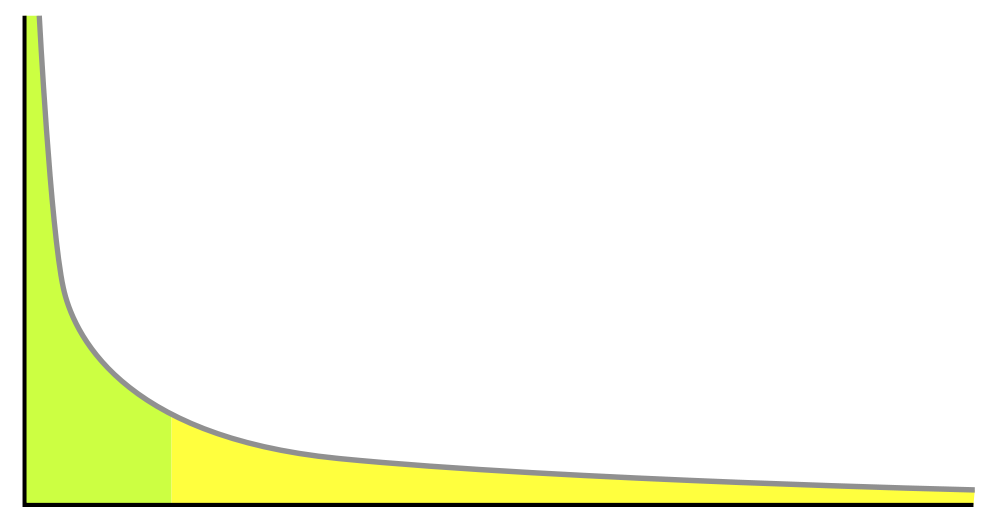
In statistics, there is a concept known as the long tail, relating to the distribution of certain events (fig 1)

Fig 1: A Long tail curve

(Source Wikipedia; “Long tail” by User:Husky – Own work. Licensed under Public Domain via Commons – https://commons.wikimedia.org/wiki/File:Long_tail.svg#/media/File:Long_tail.svg)

In our case, we could say that the Y axis represents public visibility and the number of practitioners on the X. As can be easily seen, a few practitioners are highly visible and could therefore be considered well known. The rest are all at about the same level. If we applied our Pareto concepts to this, the curves fit and 20% of the people have 80% of the visibility. Great news for them, not so for the rest of us.

How do we go about moving from the unseen to seen? By creating more awareness? This is where the noise problem kicks in. If we are all shouting louder to attract attention, the noise floor just raises, burying the wanted signal in the unwanted clutter. Noise is, as stated, any unwanted signal on a specific channel. Most people have fallen for the myth that communicating via social media is the way to go, to collect followers and post lots of fun things to them. However, time the posts wrongly, include things that people don’t want to hear and you become noise, another missed or irritating signal. So you can either get around this by turning the signal up, posting more often, collecting more followers, likes etc and hope it has the desired effect or you can change tack.

If we were to use a mobile comms approach, the shout louder approach is a 2G, old generation one. If you can’t get above the noise on your chosen frequency band, use a bigger amplifier. With more modern techniques, including wifi and 3/4G mobiles, we use a process known as spread spectrum. This takes the signal we want to transmit and spreads it out across the transmission medium, allowing it to avoid noise, jamming and requiring less overall transmission power. It requires sychnronisation between receiver and transmitter, a process that is handled and agreed at initial set up.

Applying this to a clinical field, if we want to communicate with our current or potential client base, we need to communicate over several different frequency bands, at a known rate and with information that is valid to them. For example there is no point having an active Facebook page if your clients are over 50, never use social media and are very local to you. Instead, we need to use the current base as hopping amplifiers, taking our signal and passing it on. This also allows us to use the trust generation, where one person implicitly trusts a connection, since their friend does. This can require both a driven and request based protocol, where we either ask the person to refer us or produce something that they will want to pass on, spreading our message.

How does all of this relate to the long tail? Without a well structured communication and client generation plan, we are within that tail, an issue also connecting to income. The 20% that might be getting the visibility may also be the ones getting the patients / income. In the creative industries, there are a couple of thinkers who talk about true fans. A true fan is one who buys all of the paintings a particular person makes, goes to see their shows, tells their friends and so forth. With a comparatively limited number of true fans, the artist can make a living, the number required varying with the art form (a musician may need far more than a painter as their average unit price would be lower). We too need fans, people who not only amplify our signal but who can provide us with some form of regular and steady income. Once you sit down and figure out how many you need, you can develop your strategy from there, so that your message is spread correctly, focused and not considered noise.

You don’t need to lift yourself up above the noise floor, just make sure your signal gets received by those who should see it.

Shoulder pain – Lat chain

If a patient is presenting with shoulder pain, once you have screened for red flags and visceral referral, we can focus on the mechanical presentations. 

Although we get taught hundreds of techniques for assessing shoulder range and function, in general a gross assessment of all planes will give you sufficient information to begin treatment. 

However, one area we tend to ignore or forget is the connections to the rest of the torso. 

We need to look at fascial chains connecting the anterior shoulder to the chest and abdominal structures and especially the role of the lattismus chain in the stabilisation of both the lumbar spine and the shoulder. 

Referring back to our core principles, we can see that if the pelvis and lumbar spine are dysfunctional then the lat chain and hence the shoulder may be recruited to improve stability. 

Therefore, whenever we see a shoulder issue, it falls on us to check further away which may lead to a more significant improvement than just working locally. 

Ask the right question

To get a useful answer, it is important to ask the right questions. 

    Rather than adding extra effort, look at what you can take away. 

    If you can only see 2 paths, look for a third. 

    If you’re trying something new, has anyone done something similar before? Even a different discipline offers guidelines.

    Does it actually need to be done?

    What one thing, done today, will have the most impact? 

    Can this be a yes or no, rather than a maybe? 

Try one next time you’re stuck and see if it helps break the restriction.

Autumn is here, winter is coming. 

As the light fades from the sky and our natural instinct to hibernate increases, the need to keep moving never lets up. 

We all wrap ourselves up in layers, go out less and eat more, often leading to a natural increase in winter plumage, just when we’re expected to dress up in party clothes. 

Some basic tips for feeling and looking healthier this Autumn:

1) Drink sufficient water and less alcohol. Dehydration as the central heating comes on needs to be countered, 2 litres a day is a good target. 

2) Eat a balanced plate. However much you crave cakes, soups and stews, we still need our vegetables and fruit. 

3) Move. Combat the urge to stop by walking, lifting weights or just doing something active. This has been shown to help improve mood, manage weight and keep us living longer. 

4) if you’re feeling really flat, check in with your gp practice to ensure you’re not suffering from a background grumble. If appropriate, get your immunisations to protect against winter viruses. 

5) Vitamin D supplements can really support those who get the winter blues, as we need sunlight to make it in our skin and stores run low when there’s less UV. 

And of course, come and see us to get those niggles sorted out. Osteopaths spend 4-5 years training at university standard so we are well equipped to help discuss any biomechanical aches and pains. 

We’ll see you soon. 

A useful tool for client profiles

Every day, we take clinical histories of patients and basic medical backgrounds.

Very often, we also do basic biomedical testing – height, weight and blood pressure, to give a brief picture of any issues that need to be addressed immediately.

To allow me the simplicity of calculating the clients Body Mass Index, Guideline Basal Metabolic Rate and Bodyfat percentage, I created an excel spreadsheet.

It also outputs a number of other trackable variables so you get the best bang for your buck!

This is attached here: Formula Tool

It allows for age, and sex as well, so might provide a useful reference guide.

The secret to staying young… Revealed!

Everyone experiences it in sightly different ways, but until science is able to halt biological aging, getting older is far better than the alternatives.The basic processes have a number of negative effects. Past the age of 40, and sometimes earlier, the body starts to slow down. Other than the obvious hormonal changes of the menopause or drop in testosterone, we begin to lose bone mass, muscle mass and neural communication speed. The microscopic cellular damage accumulated during life finally starts to overwhelm the repair processes, so the cellular systems tend to function less efficiently.

As this is a subtle and slow process, it is often not noticed until we realise we are able to do a less than before, that our balance is not quite as good and if we injure ourselves, it takes longer to heal.

The good news is that we can significantly slow this inevitable slide with a few simple concepts.

1. Lift weights. The saying use it or lose it is never more true than with muscle mass. Resistance work has been shown to preserve strength, help keep mental faculties and protect against illness. It also makes a significant difference if you do have to be admitted to hospital as you have more to keep you going and healing.

2. Mobilise, stretch and keep supple. Joints and soft tissue can lose their elasticity, so keeping them long and fluid will help you move better

3. Combine short high intensity bouts of exercise with lots of movement. This has been shown to keep body and brain firing more effectively and although you may not break records, challenging the body forces it to stay active.
4. Keep an eye on your diet. We are what we eat in every way. Protein is important, as is fat. Carbohydrate starts to become less so and gaining weight is not inevitable.

5. Learn new mental and physical skills. It was always thought that the brain stopped developing once we hit a certain age but research shows that we maintain a huge amount of flexibility and learning potential throughout life and are able to lay down new neural connections all the time.

This may seem like a long and tedious list but incorporating it should be simple. A few sessions of high intensity weight lifting week in a well supervised environment covers the skills, resistance training and high intensity areas, watching what you eat is as simple as checking what you stick on a fork and learning new information is at the click of a mouse with the Internet.

Aging is inevitable, getting older isn’t.