You are what you do.

They presented with a long history of shoulder and back pain, with occasional headaches, particularly in the evening. No other significant complaints, simply a tight and painful upper back, and shoulders, with a stiff neck.

After taking a thorough history and checking pertinent red flags, I carried out a suitable examination, looking at how they used their body, how it wanted to respond passively and actively.

And the thing was, other than the presenting complaint, there wasn’t much to be found. An anteriorised head posture and slightly kyphotic thoracic spine, but nothing much more than you might expect for a modern lifestyle. They exercised frequently, were not obese and tried to optimise their working posture when at a desk.

I treated what I found, and we addressed a few issues, but I was unhappy with their progress, as the complaint didn’t feel like it was resolving along the curve I expected.

Then it clicked. Whenever I went through to reception to collect them, they were playing with their phone. Head slumped forwards on the chest, looking down at the tiny screen and typing or scrolling away.

The problem is, modern expectations are that we are constantly connected, with rewards and punishments meted out by both the device and other people if we do not respond to its electronic siren call. I am as guilty as the next person, at instinctively checking and wasting hours.

It was this small, but frequent behaviour that was causing, in this case, the shoulder pain. Looking down was loading the back of their neck, the shoulders were coming in to support the arms holding close and everything matched when I mimicked them.

However, other than taking the phone away from them, there wasn’t a direct intervention I could do, so instead we discussed possible mitigation strategies, to reduce the automatic reaction, shorten the time spent interacting and change the posture, things that have been shown to work.

Following the rules of three, I suggested:

  • Switching on greyscale. This, interestingly, makes the device far less stimulating, but still allows you to work effectively. It also helps increase battery life on some devices.
  • Clean up the home screen and put apps that distract in a folder so you don’t see them first
  • Turn off notifications for social media applications

The point was simply to create a brain pause that allowed for a moment more reflection before the action, rather than create a wholesale change that would more likely fail.

Having created this awareness and put in some simple measures, we were both very happy to see that the treatment was then far more effective and the presenting issues resolved.

After they had left, I reflected in how the simple actions we do can have profound impacts and that, as practitioners of every discipline, we need to continue to look at the whole person, not just the complaint.
Breathing mechanics and change

When we consider respiration, most of us will think of it as breathing in and out. Those with a science education will then look at the passive gaseous exchange taking place across the membranes within the alveoli and the processes taking place deep in the cells. A medic will be able to look the physiology, the gases themselves and the state of the arterial blood and have a good run at diagnosing many medical conditions. If you are unfortunately hospitalised, 2 of the prime observations we make will be your respiration rate and your oxygen saturation in your blood.

In the end, this means very little but has a huge consequence on our lives. If we cannot breath well, we cannot live well.

Whenever we are challenged or threatened, our breathing will change. If we are shocked or surprised, we will instinctively hold our breath. Fine for a few seconds, less useful when we need a balanced oxygen / carbon dioxide ratio for thought and efficient brain function. So if you are permanently on edge, it may be that you spend most of your time holding your breath, leading the brain to chronically adjust the carbon dioxide / oxygen ratios (measured at the aorta). This breath holding pattern may also lead the brain to consider all things a threat, be that sport, academic or practical.  And, if our respiratory mechanics are dysfunctional, for any number of reasons, then we will not be as efficient as we can or should be, which can also lead to this challenged patterning at a neuromuscular level.

From a practitioners perspective, we need to consider not just the anatomical structures directly involved in respiration, but those tethered and related to it. As an osteopath, respiration is probably the most important system I am able to directly influence. More so than circulation (apologies to A.T Still). The rule of artery is important, but if there is poor gas balance and compromised respiration, then all other systems will be adapting to compensate, assuming blood flow is present at rest.

To me, the respiratory system starts with the nose and the sinuses in the head. It includes the standard elements of trachea, bronchi, lungs and diaphragm, but also needs to include the thoracic and lumbar spine, the ribs and even the hip flexors and all surrounding musculature.

If I can create sufficient change within in any of these elements, then I can create a positive shift in state. If I can change state, I can positively influence the health of the whole body.

Breath better, move better, be better.

Humans – viral story transporters

We live through stories. We share them, learn from them and pass them on to others.

Health and medicine are just the same as any other area and the stories we tell can kill or cure. Once humans were recognisably human, and language had formed, the stories began. This plant hurts, this plant makes you feel better. Don’t eat that without preparing it this way.

Relationships within the stories developed, changed. If you have this complaint, this plant will help, these symptoms can often be caused by that berry. With that knoweldge came specialisation, the selection of people to carry the story on, to learn and use its power. The medicine man, the hedgewitch.

The very messy practicalities of medicine called for many different people to carry out other roles, barber surgeons becoming surgeons, village grandmothers to midwives, story tellers and escorts in and out of life.

Now, we still have those stories but the specialisation has become even finer. If a person comes to you with low temperature, risk of infection, a high pulse and high breathing rate, they might have sepsis. If another person comes to you with a cough that makes them gasp, but only comes on with exercise, they might have asthma. We trust the knowledge held in these stories to doctors, to people who dedicate their working lives to learning and passing on the stories.

Therefore look around you at what you do, how you share with the people you connect with. Could you tell better stories, share your knowledge in better ways?

Find the key to the story and watch it spread better. Don’t be scared of losing it, it’s never been yours anyway.

The long tail problem and noise floors in clinical practice

In engineering, there is the concept of noise. This is generally considered to be any unwanted signal in a source and can create huge issues in many areas by masking the desired information. In clinical practice, this noise problem is seen whenever patients are telling us lots of information but not necessarily the things we need to hear and also when we are trying to promote our practices to the wider public.

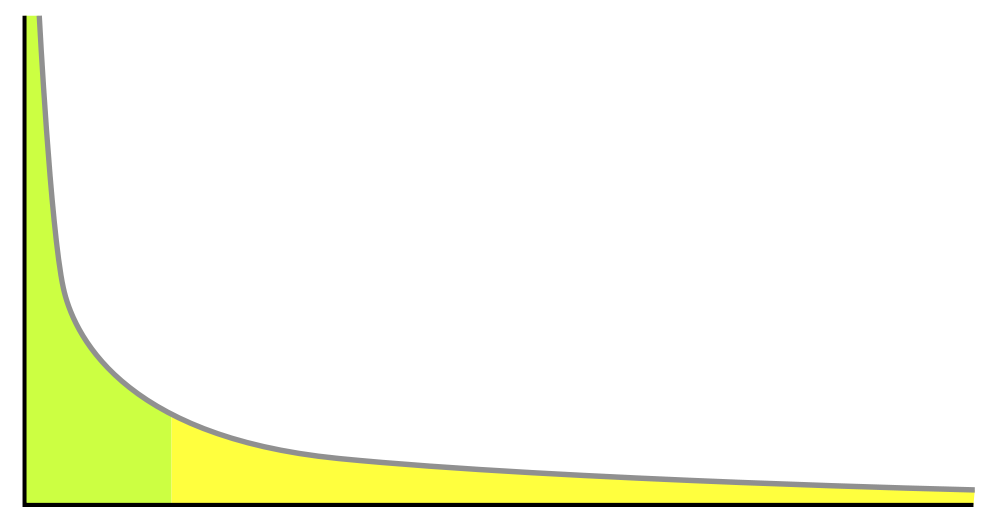
In statistics, there is a concept known as the long tail, relating to the distribution of certain events (fig 1)

Fig 1: A Long tail curve

(Source Wikipedia; “Long tail” by User:Husky – Own work. Licensed under Public Domain via Commons – https://commons.wikimedia.org/wiki/File:Long_tail.svg#/media/File:Long_tail.svg)

In our case, we could say that the Y axis represents public visibility and the number of practitioners on the X. As can be easily seen, a few practitioners are highly visible and could therefore be considered well known. The rest are all at about the same level. If we applied our Pareto concepts to this, the curves fit and 20% of the people have 80% of the visibility. Great news for them, not so for the rest of us.

How do we go about moving from the unseen to seen? By creating more awareness? This is where the noise problem kicks in. If we are all shouting louder to attract attention, the noise floor just raises, burying the wanted signal in the unwanted clutter. Noise is, as stated, any unwanted signal on a specific channel. Most people have fallen for the myth that communicating via social media is the way to go, to collect followers and post lots of fun things to them. However, time the posts wrongly, include things that people don’t want to hear and you become noise, another missed or irritating signal. So you can either get around this by turning the signal up, posting more often, collecting more followers, likes etc and hope it has the desired effect or you can change tack.

If we were to use a mobile comms approach, the shout louder approach is a 2G, old generation one. If you can’t get above the noise on your chosen frequency band, use a bigger amplifier. With more modern techniques, including wifi and 3/4G mobiles, we use a process known as spread spectrum. This takes the signal we want to transmit and spreads it out across the transmission medium, allowing it to avoid noise, jamming and requiring less overall transmission power. It requires sychnronisation between receiver and transmitter, a process that is handled and agreed at initial set up.

Applying this to a clinical field, if we want to communicate with our current or potential client base, we need to communicate over several different frequency bands, at a known rate and with information that is valid to them. For example there is no point having an active Facebook page if your clients are over 50, never use social media and are very local to you. Instead, we need to use the current base as hopping amplifiers, taking our signal and passing it on. This also allows us to use the trust generation, where one person implicitly trusts a connection, since their friend does. This can require both a driven and request based protocol, where we either ask the person to refer us or produce something that they will want to pass on, spreading our message.

How does all of this relate to the long tail? Without a well structured communication and client generation plan, we are within that tail, an issue also connecting to income. The 20% that might be getting the visibility may also be the ones getting the patients / income. In the creative industries, there are a couple of thinkers who talk about true fans. A true fan is one who buys all of the paintings a particular person makes, goes to see their shows, tells their friends and so forth. With a comparatively limited number of true fans, the artist can make a living, the number required varying with the art form (a musician may need far more than a painter as their average unit price would be lower). We too need fans, people who not only amplify our signal but who can provide us with some form of regular and steady income. Once you sit down and figure out how many you need, you can develop your strategy from there, so that your message is spread correctly, focused and not considered noise.

You don’t need to lift yourself up above the noise floor, just make sure your signal gets received by those who should see it.

Simple is not the same as easy.

The second law of thermodynamics states that everything will get more chaotic without input.

This is universal.

If you don’t sort out the little problems, they become big.

If you want to achieve a specific goal, it will take time, energy and focus. Whatever the marketers and internet gurus say, there are no shortcuts. This is simple. It is not the same as easy to accomplish.

Let us help you get better by sorting out the little problems early. One osteopathic treatment ahead of time can save lots of time, money and injury by catching things before chaos catches you.

Shoulder pain – Lat chain

If a patient is presenting with shoulder pain, once you have screened for red flags and visceral referral, we can focus on the mechanical presentations. 

Although we get taught hundreds of techniques for assessing shoulder range and function, in general a gross assessment of all planes will give you sufficient information to begin treatment. 

However, one area we tend to ignore or forget is the connections to the rest of the torso. 

We need to look at fascial chains connecting the anterior shoulder to the chest and abdominal structures and especially the role of the lattismus chain in the stabilisation of both the lumbar spine and the shoulder. 

Referring back to our core principles, we can see that if the pelvis and lumbar spine are dysfunctional then the lat chain and hence the shoulder may be recruited to improve stability. 

Therefore, whenever we see a shoulder issue, it falls on us to check further away which may lead to a more significant improvement than just working locally. 

New year, new you. 

Rubbish. 

It’s another day, 24 hours after you probably ate and drank to excess. 

It’s one more rotation of the planet, on a calendar defined by an Italian pope several hundred years ago. 

And it’s the chance, just like any other day, to start again, get disciplined, and change one thing. 

I’ve written several times on finding the one or two things that have the most significant impact. In this case, think about what you can cut out. What, if you take it away, could have the most impact? 

If you smoke or drink frequently, cutting it out not only improves health but improves your purse. 

If you’re thinking of joining a gym, start by cutting out the worst rubbish from your diet instead and walking more. 

Instead of turning on the tv, work through some basic mobility. 

Don’t look at Facebook for the tenth time today, read a real book. 

Make a small change, with consistency and reap huge benefits. 

Autumn is here, winter is coming. 

As the light fades from the sky and our natural instinct to hibernate increases, the need to keep moving never lets up. 

We all wrap ourselves up in layers, go out less and eat more, often leading to a natural increase in winter plumage, just when we’re expected to dress up in party clothes. 

Some basic tips for feeling and looking healthier this Autumn:

1) Drink sufficient water and less alcohol. Dehydration as the central heating comes on needs to be countered, 2 litres a day is a good target. 

2) Eat a balanced plate. However much you crave cakes, soups and stews, we still need our vegetables and fruit. 

3) Move. Combat the urge to stop by walking, lifting weights or just doing something active. This has been shown to help improve mood, manage weight and keep us living longer. 

4) if you’re feeling really flat, check in with your gp practice to ensure you’re not suffering from a background grumble. If appropriate, get your immunisations to protect against winter viruses. 

5) Vitamin D supplements can really support those who get the winter blues, as we need sunlight to make it in our skin and stores run low when there’s less UV. 

And of course, come and see us to get those niggles sorted out. Osteopaths spend 4-5 years training at university standard so we are well equipped to help discuss any biomechanical aches and pains. 

We’ll see you soon. 

Simple is not the same as easy.

Losing weight is simple. Burn more energy than you consume.

Getting fitter is simple. Train smart as well as harder. 

Being richer is simple. Earn more, spend less.

But is never seems to work like that. It is the details that hold us back. Losing weight generally means losing bodyfat, and the techniques required for that depend on your starting point. Getting fitter is similar. Starting from zero, anything is an improvement, but the closer we get to the goal, the more the process has to be refined. 

And, the further we go into the weeds to find the shortcuts, the more complex it all seems to become. We can get snowed under in the details, the little things that seem to become important in the eyes of a self proclaimed expert.

Keep in mind, the simple things. Fuel well, drink water, move more. And if you get lost or stuck, come back to those.

As for getting rich? Find something you enjoy doing most of the time (no one loves their job every day) study hard, try to find a balance between work and play, and don’t spend as much as you bring in. Good luck!


Listen to your gut

Too often you’ve heard the phrase “You are what you eat”. But have you considered the effect of what you eat on your performance, mentally and physically?

We all know caffeine can give you a pre workout boost, carbohydrate drinks are sometimes necessary for energy during a long session and a good recovery meal helps you prepare for the next one. We also know that some people suffer from significant allergies and intolerances that have a huge impact on their lives.

But what if what you were consuming was having a negative effect on you? Not catastrophically but in little ways. That the bread roll with your soup at dinner had triggered a little bit of gut irritation which reduced your capacity to perform through mediated inflammation? That a spot of reflux and indigestion from eating too late and too much had stiffened up your thoracic spine, leading to an inability to squat as efficiently?That the beer to celebrate a good result had set off a minor chain reaction leading to a niggling injury due to reduced healing capacity? That the fructose in your sports drink started a series of cravings for other sugary treats later in the day?

All of these are not uncommon cases of tiny adverse reactions to food and drink, but we too often ignore them. Thats not to say that we need to be utterly soulless and controlling about our diets, simply aware that what we put in has a dynamic and often medium term effect on our ability to perform optimally.

Pay a little more attention to the effect of what you consume and reap the rewards long term.