On being a god

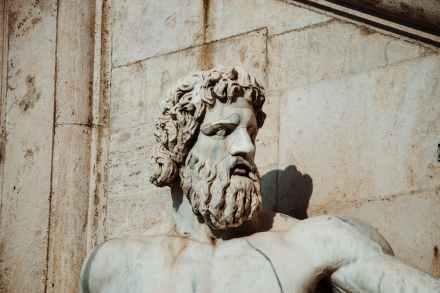
So you want the body of a god. Pick your pantheon. Greek, Roman, Norse. All images are interpreted by artists and storytellers, so what you’re actually wanting is the body that a painter, sculpter or mosaicist created to symbolise their desires. I wanted the body of a god and got Dionysis.

Anyway, god, or goddess, it is.

First, to be like a god, live like one. Perhaps without the destruction and disinterest in the humans, but in other ways, train, sleep, eat like a goddess.

The norse gods would have had fish, grains, meat, washing it down with beer (mead is for celebrations). The greek or romans? Fresh fish, fruits and vegetables, olives, breads, cheeses. What you put in, is what you get out and eventually the body composition will follow the diet.

The one thing none of the diets would had would have been confectionary (other than sweet cakes, ambrosia and dried fruits), and processed foods.

As for training, for the greeks, lots of running, throwing, lifting (think olympic disciplines). The norse, heavier lifts, walking, hunting and rowing. They created their gods from what they knew.

To be like a god, first live like one.

What has any of this got to do with a sports injury clinic?

Firstly, I firmly believe that we forget the basics to follow the latest trend or fad. Secondly, we are what we consume. Thirdly, even the gods needed help and support sometimes and having an expert at your side when you go on the journey is a good thing.

We can offer nutritional reviews, training and planning support and treatment for those injuries sustained in the cause of achieving your goals.
On: Finding the one thing

Sometimes it takes only one thing to start the rock rolling, the pebble that is stopping the landslide of success.

Sometimes, once you find that one thing, everything else falls into place and it becomes brighter, easier, smoother.

However, finding that one thing is very difficult, as it is different for person, goal, and phase of life.

And sometimes, it doesn’t matter what the thing is, as starting anything can help.

Maybe you want to lose weight for health reasons (there aren’t really any other valid ones). Maybe you feel you need to improve your fitness (there could be a couple of reasons here), perhaps you feel stuck in a relationship (a multitude of reasons in there), or you’re at a fork in the road with regards to career.

Lets take health (we are a health organisation after all) and weight management. There is ostensibly a simple recipe for this. You want to lose weight, burn more calories than you consume, you want to gain wait, eat more. Now, lets take into consideration motivation, working and life paatterns, underlying health status, stress, prior exercise history, gender, nutritional history and current nutritional status and see how we go? Which one thing is going to unlock the magic box of slimmer?

For most people wanting to lose weight, it will simply being aware of what they eat and when. That awareness helps them tune their consumption. For others, who have a reasonably good grasp on it, moving a bit more frequently and with higher intensity could be the key. A more complex case might be the older person with underlying health conditions, who will need more close monitoring, motivation and coaching to ensure they maintain both good nutrition and reduced risk.

To find your one thing, contact us for a consultation. We don’t just do manual therapies, we support weight management journeys, fitness plans, proactive healthcare discussions and personal accountability coaching.

Understanding the Vagus Nerve: Myths vs. Facts

Stressed? Tired? Anxious? Run down? Digestive issues? Just not feeling the spark in the bedroom? Perhaps your Vagus Nerve needs resetting!

Or so many practitoners will try to persuade you. And of course they will share the secrets of their protocol for only 10 dollars and your email address.

Fact: The vagus nerve is the 10th cranial nerve, and one of the only ones that leave the skull to travel around the body (Vagus – Wanderer – Vagrant). In the case of the vagus nerve, it heads down the neck, outside of the spinal cord, and acts as the parasympathetic highway, adding control to the heart, digestion, major solid organs and even your response to inflammation.

So yes, if you are experiencing a huge variety of issues, then the vagus nerve is likely to be involved, especially if there is a psychological component.

However. A vagus nerve reset isn’t a secret protocol or a mystic trick, and it may not make all those issues go away, especially if you haven’t actually made a start at dealing with the underlying issues leading to them.

Want to reset your vagus nerve? Do anything that relaxes you. Breathing exercises, meditation, gentle rythmic exercise. As long as its not excessively stimulating and you enjoy it, it’ll work.

Some research also shows that there is a relationship between heart rate variability and the vagus nerve, and that asymmetric breathing (short nasal in, long pursed lip breath out), can help this.

When you look at it closely, most of the online information regarding resetting the vagus nerve is actually long term lifestyle management, with a funny hat. Change your diet, control your stress, exercise and train in a manner that supports your health. And most importantly, breathe.

Simple, cheap, effective.

And of course, always consult an expert when considering such things, to make sure that you are solving the correct problem.

On: Suffering

Suffering – to undergo pain or hardship.

Suffering is a subjective experience. Experiencing is objective. The difference is critical, and multifaceted, but is essentially context and control.

A person has a respiratory virus. They experience all the symptoms of congestion, headache, sneezing, fatigue. They only suffer with a cold if it makes them miserable as well. And if it does, thats allowed. Being ill is awful.

People in conflict zones undergo extraordinary hardships, as destruction and the potential for death surround them, with little opportunity to escape. And yet, so many of them are far more resilient than those of us who fall apart if Disney+ cancels season 2 of our favourite show. Somedays, especially with loss, grief and pain, I am sure they are suffering enormously.

The same goes for many other areas. People experience a life changing injury. They only suffer if they don’t get the support, medical care and rehabilitation that they need to allow them to return to independence and a fulfilling role in society, AND, they choose the path of misery and suffering, with the adjacent loss of control.

That choice is hard. Incredibly so. It is a choice they make every day. To suffer, or to experience, to live with or in spite of?

From having spent many years with these people, I admire them all, and especially the ones who choose to lean in to it.

From them, and from conversations with many of them, as well as reflections of my own, I offer the following thought.

It is.

Today it is hurting. Today is is raining, Today I have a cold. Today I have a back pain and didn’t sleep well, the children are playing up and I have worries about the council tax bill.

But.

I am still me, I am still a parent, I am still loved, I am still interested in art, science, reading, steam engines of the mid 20th Century, whatever forms part of your self identity.

It is, I have, not I am.

Labels are for shopping, or nasty little lists. Don’t take a label.

I am, it is.

On: failure

If you try to do too much in one go, you’ll fail.

You’ll fail because change requires effort and energy to sustain and you only have so much of it to go around.

Getting up earlier requires going to be earlier. But you can’t do that if you have commitments that keep you busy.

Cleaning up your diet requires knowledge, planning, effort.

Going to the gym is bullshit. I love gyms, they’re generally my safe place, but they are not the panacea sold by fitness grifters. Gyms are a place of effort, learning, painful self reflection. Go when you are ready for the lesson and can take humility in your kitbag.

Meditation and mindfulness are not solutions, they’re tools. If you can’t accept the dancing monkeys in your head, you’re not going to want to spend any time with them.

And after all that negativity?

Get rid of something. Less is far easier to manage than more.

Stop drinking. Stop smoking. Stop scrolling. If you can’t, accept you might have an addition issue and ask for support.

Walk more, drive less.

Throw out something from your house. It’s almost certainly clutter and there’s a probability someone else could benefit.

Positive deeds are loops. One feeds another. Make space for positive things.

We can offer some of this support.

An exercise review. A safe space to work through basic coaching issues, treatment to give your body space in itself to heal. A motivating kick and gentle reminder that being human takes effort but is worth it.

But make space. Do less, just do less better.

Be kind, be curious.

On: The power of words

Words have power. This has been known for a very, very long time.

The words we say to each other, the words we say to ourselves and the words we use to describe the world around us.

By reframing the words we use, we can change the way we view the universe. Even the language we speak with changes the way we interact with the world around us.

The internal monologue we have can change our entire day, or even path of life. So does everyone elses. And of course, these things can be deep and challenging to deal with, so are far beyond the remit of such pages here.

With that in mind, the following are suggestions that can allow us to catch ourselves in simple situations that may then offer benfit to the way we approach certain circumstances.

For example. You injure a knee on a run, which limits your mobility while it heals. If you start telling yourself that you cannot do things because of your knee, then you are creating limitations within your mindset. However, simply by saying that in spite of the knee you can do activities that maintain your fitness, you will optimise recovery, improve your mindset and view the current difficulty in a better light. That is not to say that it is not a difficulty, but the perspective shift of the barrier changes its height.

Or. Change “I can’t” to “how can I?” Shift the view of the problem.

Within a medical setting, we often get patients expressing suffering. Suffering is subjective, valid and to be believed. However, as a professional, you can help reframe the situation by the use of your language patterns to check in with what they are experiencing. From suffering to experiencing does not and should not invalidate their personal reality, but may help explore what it means at that point.

Again, within a medical or caring setting, empowerment is important. If we help someone, we can often disempower them and either create passisivity or an unbalanced dynamic. So instead of helping, consider or ask how you can support them. If they have limited abilities for any reason, then this can help set the correct tone for them to communicate their needs, rather than having your “help” thrust upon them.

If you have repetitive and perhaps tedious tasks to help those around us, from small children and work colleagues to aging relatives, and find yourself saying that you’ve got to, reframe it to get to. I’ve got to take the kids to football – I get to watch them learn new skills. I’ve got to see my grandfather this afternoon – I get to spend time with my grandfather. And so forth.

And sometimes, if you don’t know what to say, say nothing. Supportive silence is much underrated and certainly underused. Slow down, check in with yourself and say nothing.

In spite – because of

Can’t – how can

Suffering – experiencing

Got to – get to

Silence.

Onwards.

On: Rituals and routines

It seems like every influencer has their own special ritual and routine that helps them optimise their productivity, create more wealth and still manage to find time for their side hustle / thruple / vanlife trip around the pacific north west. And you can learn the secret if you listen to their podcast / buy their e-book / subscribe to their youtube channel.

And if thats true then I’m pleased for them, they’ve achieved some sense of balance and awareness in their lives.

For the rest of us, those who don’t speak fluent Aspiranto (the common language of the Antisocial media personality), some of the ideas can still offer us a benefit, especially if we draw our attention to them.

First though, definitions.

A routine is a sequence of actions that are repeated regularly, often without much thought. They can be simple, like brushing your teeth before bed, or more complex, like going to the gym regularly. As well as saving time and energy, they can also provide us with a sense of structure and predictability.

Rituals are also a series of repeated actions, but they are typically more intentional and meaningful than routines. Rituals can be religious, spiritual, or secular. Often performed less frequently, they can be performed to mark important life events, to connect with others, or simply to find peace and calm.

However, it is important to note that the distinction between routines and rituals is not always clear-cut. For example, a morning routine of yoga and meditation could be considered both a routine and a ritual, depending on the individual’s intention.

And herein lie the key differences: Intention, Attention, Focus.

To turn a routine into a ritual, we have to be fully present in the process. We have to understand the why , not just the what, and allow that awareness to be part of the process. And, we can often use symbols and anchors to help us trigger those patterns more effectively.

If, for example, you were brought up in the Western Christian Catholic tradition, then the smells and the bells would automatically allow you to access the full script for the ritual taking place, whereas it could seem confusing and overwhelming if you had never experienced it before.

These symbols and anchors can all be used to create a sense of belonging in those who have been initiated, and may create a barrier to those who are outside.

So, to improve an aspect of our lives, we can create a routine to support it. Want to drink more water, put in place a structure that encourages this with the use of triggers and anchor points. Feel that a 5 minute mobility routine would offer some benefit to your overall health? Make it simple to carry out. Look at what is currently stopping you and remove those barriers.

And, to make the mobility a meditation, or to use the water break as a gratitude practice (both of which are backed by real science to offer benefit), then choose your focus in the moment to be on your breath, on the process, on reflection, rather than carrying out the motions.

On: Testing and Imaging

Just because you can, doesn’t mean you should.

As a clinician, there are a huge range of tests and investigations available. Blood tests, scans, investigations, the list of what you can order goes on and on.

Some of them are quite invasive and unpleasant for the patient to go through. Others can expose them to small doses of radation. And all of them have a cost.

How do you choose which to use? The first step is to listen to the person and understand their clinical history. From that, and in conjuction with an appropriate and consented examination, one develops differential diagnoses. And only then, do we start to consider tests to confirm or exclude the diagnosis.

And of course, we have to consider, or at least should take into account, what we will do with the result of the test.

Blood tests can give an idea of the current status of many organs, but if you are complaining of UTI symptoms, i don’t need bloods, I just want a non invasive dip and will treat according to that. However, if I believe that you are anaemic and want to understand why, then a blood test may help, and guide the treatment. And if I believe there is something complex, where it shouldn’t be, then I will want to image it, whilst referring you to the most appropriate speciality.

This is especially true for complex and expensive imaging routines, such as MRI or CT. If you have simple musculoskeletal back pain, and no indication for surgery, then an MRI is not going to change matters. If your clinical history indicates a complex presentation that may require intervention then an MRI or CT is an effective next step. For context, a CT is Computed Tomography, essentially a three dimentional thin slice x-ray model, which is good for seeing hard structures. MRI is Magnetic Resonance Imaging, and best suited to soft tissues and organs.

However, far too many professionals request tests as a holding pattern, so that they feel they are doing something, and are reassuring both the patient and themselves that they are being proactive. This is not a judgement on clinical practice, simply an observed trap that we all fall in to and should be aware of.

So, as a patient, or patient advocate, take the time to check with the person what the test is for and why they think it will help. This will give them the opportunity to educate you, explain their thinking and hopefully answer any questions you may have.

From knowledge comes understanding. From understanding comes courage.

On: Galen

The history of medicine is littered with men, and women, who even today, have an impact on the way we treat and are treated when we are ill.

One of these, and one of my favourite, was Galen. A Greek physician who practiced in the 1st Century CE Roman Empire, he studied extensively before moving to Rome and eventually becoming physician to the Emperors, and Gladiators. This gave him significant insight into many areas, and although we now know that many of his thoughts on illess and physiology are incorrect, a great deal of his work is still relevant.

Two of his tenets, which I believe still stand, and we still use are:

The body is a complex interconnect system, which has the capacity to heal itself. This is very similar to the osteopathic principles.

Use physical therapies first, then drugs, then surgery.

This last principle is still undervalued by both patient and practitioner, as it is not an easy fix, and given today’s current phamacopea, it is too easy to reach into the cabinet and take a pill rather than look for an underlying cause.

I would advocate to choose to be different. Seek the cause, make a change and overall health will improve.

How we move affects how we think

There is a connection between how we move, how we breathe and how we think. This connection is well known and recognised in many traditions, and even by a running shoe manufacturer, but most of us ignore the cues that are there, if we were to tune into our bodies a little more.

I was discussing this recently with a professional singing and breathwork coach, and having worked with people with varying levels of paralysis, it is possible to see the way thought is entrained to the breath cycle.

As the coach showed me, we begin each thought with a breath and generally reach the end of the thought before the end of the breath. However, if we are unable to hold a deep breath for long enough, our thoughts can get chopped off by the need for air.

Thus we may begin the thought again, creating a frustrating cycle of thought and breath. But by allowing ourselves the space to breath and think, to move and breath, and to move and think, by acknowledging that this cycle takes place then we can help it all to work more effectively.

And, through seeking professional support, to optimise our breathing, to find balance in the respiratory system as well as the rest of the body, then we can improve even more.