You are what you do.

They presented with a long history of shoulder and back pain, with occasional headaches, particularly in the evening. No other significant complaints, simply a tight and painful upper back, and shoulders, with a stiff neck.

After taking a thorough history and checking pertinent red flags, I carried out a suitable examination, looking at how they used their body, how it wanted to respond passively and actively.

And the thing was, other than the presenting complaint, there wasn’t much to be found. An anteriorised head posture and slightly kyphotic thoracic spine, but nothing much more than you might expect for a modern lifestyle. They exercised frequently, were not obese and tried to optimise their working posture when at a desk.

I treated what I found, and we addressed a few issues, but I was unhappy with their progress, as the complaint didn’t feel like it was resolving along the curve I expected.

Then it clicked. Whenever I went through to reception to collect them, they were playing with their phone. Head slumped forwards on the chest, looking down at the tiny screen and typing or scrolling away.

The problem is, modern expectations are that we are constantly connected, with rewards and punishments meted out by both the device and other people if we do not respond to its electronic siren call. I am as guilty as the next person, at instinctively checking and wasting hours.

It was this small, but frequent behaviour that was causing, in this case, the shoulder pain. Looking down was loading the back of their neck, the shoulders were coming in to support the arms holding close and everything matched when I mimicked them.

However, other than taking the phone away from them, there wasn’t a direct intervention I could do, so instead we discussed possible mitigation strategies, to reduce the automatic reaction, shorten the time spent interacting and change the posture, things that have been shown to work.

Following the rules of three, I suggested:

  • Switching on greyscale. This, interestingly, makes the device far less stimulating, but still allows you to work effectively. It also helps increase battery life on some devices.
  • Clean up the home screen and put apps that distract in a folder so you don’t see them first
  • Turn off notifications for social media applications

The point was simply to create a brain pause that allowed for a moment more reflection before the action, rather than create a wholesale change that would more likely fail.

Having created this awareness and put in some simple measures, we were both very happy to see that the treatment was then far more effective and the presenting issues resolved.

After they had left, I reflected in how the simple actions we do can have profound impacts and that, as practitioners of every discipline, we need to continue to look at the whole person, not just the complaint.
A reflection on training planning

When thinking about training planning, whether for personal development or competition, there are a number of variables we all need to consider, whether as the trainer or trainee.

Underlying it all and before we can even start planning, we need to work out where the following are:

  • Intention
  • Attention
  • Focus

Both for the immediate goal and the longer term structure. Once these have been identified, and there can be only one or two main intention points, then the next step can be assessed.

Here, we need to look at which phase of training we are in. If we are a beginner, or have been training for only a short period of time, then we are still in base development, where we are learning the mechanics and improving work capacity. As we improve, we can start working on the individual elements of our chosen discipline. These can include:

  • Skill
  • Stamina
  • Strength
  • Speed

These lead to a development of work capacity. Or, the ability to do something faster, more accurately and for longer and more efficiently.

When looking at each days training plan, it goes through 4 phases, the length of which dependent on the above goals and the physiological status.

  • Move
  • Groove
  • Load
  • Cruise

We first start to move, to explore the body’s capacity for work that day, consider recovery from the last training session or injury. We then start to groove in the movements that we will be training that day. Once warm and ready, we can finally get the load moving, whether that is under a barbell, a HIT phase or a bike ride. Once we have completed the scheduled work, we finally cruise down, checking in again to note how we went, and to feedback for the next session.

The final, often overlooked and probably as important element of training is the recovery and nutrition. However, we tend to look at the work rather than the recovery, believing that more is better, which for most people, it tends to be, given the rest of their lifestyles, but with that, the nutrition element still has to be considered, and for most people, should be one of their two main attention points. Nutrition is a huge, complex and troublesome area, can be generally be summed up succinctly as:

“Eat meat and vegetables, nuts and seeds, some fruit, little starch and no sugar. Keep intake to levels that will support exercise but not body fat”

Greg Glassman

Now, forget everything, go and play.

5 daily habits, 3 basic skills

There are 5 habits we do every day, and that most of us take for granted. They are the basic skills needed to function well in everyday life, well before the more complex elements of household management and navigation in a modern society come in to play.

Yet when we are unable or unwilling to perform them, it’s time to ask for help from those around us, as they are the foundation stones on which all other skills rest. These are the things that our primary carers would have taught us to do by the time we were ready to leave home and almost all of us will have done today.

  1. Get up and make your bed
  2. Perform a personal hygiene routine and dress appropriately
  3. Prepare and eat a nutritious hot meal
  4. Movement and physical maintenance
  5. Interact socially and do something creative and productive

These can be viewed as a stack, and performing one allows the next to take place more efficiently. The inclusion of creation and productivity in the list, is in my mind, crucial, as it allows us to express an important element of our personality, and its presence or absence is an indicator in our mental, as well as physical health.

The habit most people will tend to misunderstand and misinterpret is that of movement and physical maintenance. Here, there are 3 basic skills that we should be able to perform unless we have a diagnosed impairment. And, as above, the inability to do these indicates that we need to check in with an appropriate professional for support and to allow us to regain them, or plan to mitigate the risk of losing that element of independence. 

  1. Get off the floor from lying on your front
  2. Get off the floor from lying on your back
  3. Walk a mile with a moderately heavy load

These use all the primal movements (push / pull / flex / twist / squat / lunge / walk), as well as the fundamental human expression of gait.

Physical maintenance is the skill of daily self care, being able to mobilise and strengthen the body, with stretching, joint position awareness, breathing exercises and strength training. If starting this practice, after a period of relative immobility, then it is recommended that you start gently, focusing on the ankles, hips and shoulder girdle, with breathing as a guide.

The basics of positive mental health

Firstly, if you reached this via a random search on the internet and are feeling stuck, buried under unmanageable pressure, in a corner or suicidal, breathe.

If that is you now, if you have a plan, if you’re looking for ways to end your life, if it’s so dark that the relief of knowing how is a comfort, stop. Please. Call a mate, phone Samaritans, if you think you’re going to OD or have, get yourself to A&E.

If you need to self harm to relieve the pain, to give you something to focus on, try ice cubes. Squeeze them in your hand and feel the burning cold. Put down the sharp blade and open a window.

When we, as professionals, talk to people who’ve cut or attempted suicide after we’ve stabilised them, they almost all regret it. Most attempts are a cry for help, to get attention, to put down the enormous burden, to ask someone to take over, just for a while, to deal with the crap life has handed you.

If this is you, I’m sorry. I have no idea what demons you’re fighting but I do know that so many have been there before you and there is a solution, somehow. But the never ending darkness is not it. There are charities who are there to support you, pathways in place to show you that, however dark it is now, there is a way forward.

Please note that this is not about mental illness. This is not about PD, psychosis, mania or depression. These are the kind that leaves you debilitated and requiring professional assistance. For those who have such things, it is important that the rest of us do not stigmatise them, help support them in any way and be conscious that we are all a few steps and some genes away from their situation.

For the rest of us, who live every day with our own mental health, it is thankfully starting to become more commonly talked about in recent years. The typical English attitude of stiff upper lip and crack on is slowly becoming more less expected, but the underlying causes of poor mental health is less commonly discussed.

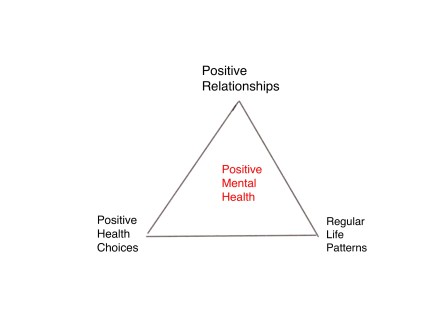
Positive mental health is much more of a holistic approach, a way of recognising that body and mind are inextricably linked, that we can influence those around us and by intercepting negative trends, and that we may be able to prevent or minimise darker times.

The sketch above shows the basic pyramid of mental health.

Positive health choices are obvious in retrospect. Avoiding drugs that effect mental state (alcohol, cannabis, tobacco, illicit chemicals), taking regular exercise, maintaining a healthy weight, getting sufficient rest.

Regular life patterns play a more subtle role. We all have a circadian clock, a biological rhythm that governs eating, sleeping, and even more complex processes. But we also have a human need for regularity. For work, for seeing friends, for doing things we enjoy. If we neglect this, or it is removed from us, we soon notice its absence.

Positive relationships make more sense. We have all had relationships that drag us down, that make us feel less than we like to be. These can be personal, romantic or work, but their effect is pernicious and corrosive.

We can tolerate shifts in any one of the points for a period of time, for example poor health choices by eating too much, drinking too much or not resting enough, but if we also have a few unsupportive or negative relationships and no regular life pattern then we are in a slippery slope to poor mental health.

Mental health is a gift to be nurtured, shared and to be grateful for.

Humans – viral story transporters

We live through stories. We share them, learn from them and pass them on to others.

Health and medicine are just the same as any other area and the stories we tell can kill or cure. Once humans were recognisably human, and language had formed, the stories began. This plant hurts, this plant makes you feel better. Don’t eat that without preparing it this way.

Relationships within the stories developed, changed. If you have this complaint, this plant will help, these symptoms can often be caused by that berry. With that knoweldge came specialisation, the selection of people to carry the story on, to learn and use its power. The medicine man, the hedgewitch.

The very messy practicalities of medicine called for many different people to carry out other roles, barber surgeons becoming surgeons, village grandmothers to midwives, story tellers and escorts in and out of life.

Now, we still have those stories but the specialisation has become even finer. If a person comes to you with low temperature, risk of infection, a high pulse and high breathing rate, they might have sepsis. If another person comes to you with a cough that makes them gasp, but only comes on with exercise, they might have asthma. We trust the knowledge held in these stories to doctors, to people who dedicate their working lives to learning and passing on the stories.

Therefore look around you at what you do, how you share with the people you connect with. Could you tell better stories, share your knowledge in better ways?

Find the key to the story and watch it spread better. Don’t be scared of losing it, it’s never been yours anyway.

The long tail problem and noise floors in clinical practice

In engineering, there is the concept of noise. This is generally considered to be any unwanted signal in a source and can create huge issues in many areas by masking the desired information. In clinical practice, this noise problem is seen whenever patients are telling us lots of information but not necessarily the things we need to hear and also when we are trying to promote our practices to the wider public.

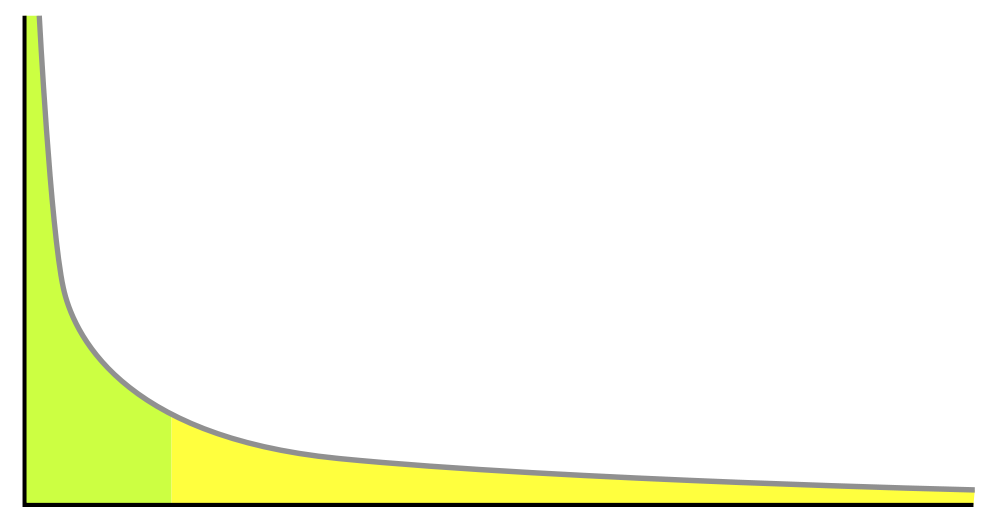
In statistics, there is a concept known as the long tail, relating to the distribution of certain events (fig 1)

Fig 1: A Long tail curve

(Source Wikipedia; “Long tail” by User:Husky – Own work. Licensed under Public Domain via Commons – https://commons.wikimedia.org/wiki/File:Long_tail.svg#/media/File:Long_tail.svg)

In our case, we could say that the Y axis represents public visibility and the number of practitioners on the X. As can be easily seen, a few practitioners are highly visible and could therefore be considered well known. The rest are all at about the same level. If we applied our Pareto concepts to this, the curves fit and 20% of the people have 80% of the visibility. Great news for them, not so for the rest of us.

How do we go about moving from the unseen to seen? By creating more awareness? This is where the noise problem kicks in. If we are all shouting louder to attract attention, the noise floor just raises, burying the wanted signal in the unwanted clutter. Noise is, as stated, any unwanted signal on a specific channel. Most people have fallen for the myth that communicating via social media is the way to go, to collect followers and post lots of fun things to them. However, time the posts wrongly, include things that people don’t want to hear and you become noise, another missed or irritating signal. So you can either get around this by turning the signal up, posting more often, collecting more followers, likes etc and hope it has the desired effect or you can change tack.

If we were to use a mobile comms approach, the shout louder approach is a 2G, old generation one. If you can’t get above the noise on your chosen frequency band, use a bigger amplifier. With more modern techniques, including wifi and 3/4G mobiles, we use a process known as spread spectrum. This takes the signal we want to transmit and spreads it out across the transmission medium, allowing it to avoid noise, jamming and requiring less overall transmission power. It requires sychnronisation between receiver and transmitter, a process that is handled and agreed at initial set up.

Applying this to a clinical field, if we want to communicate with our current or potential client base, we need to communicate over several different frequency bands, at a known rate and with information that is valid to them. For example there is no point having an active Facebook page if your clients are over 50, never use social media and are very local to you. Instead, we need to use the current base as hopping amplifiers, taking our signal and passing it on. This also allows us to use the trust generation, where one person implicitly trusts a connection, since their friend does. This can require both a driven and request based protocol, where we either ask the person to refer us or produce something that they will want to pass on, spreading our message.

How does all of this relate to the long tail? Without a well structured communication and client generation plan, we are within that tail, an issue also connecting to income. The 20% that might be getting the visibility may also be the ones getting the patients / income. In the creative industries, there are a couple of thinkers who talk about true fans. A true fan is one who buys all of the paintings a particular person makes, goes to see their shows, tells their friends and so forth. With a comparatively limited number of true fans, the artist can make a living, the number required varying with the art form (a musician may need far more than a painter as their average unit price would be lower). We too need fans, people who not only amplify our signal but who can provide us with some form of regular and steady income. Once you sit down and figure out how many you need, you can develop your strategy from there, so that your message is spread correctly, focused and not considered noise.

You don’t need to lift yourself up above the noise floor, just make sure your signal gets received by those who should see it.

One day. 

One day you may need to run. Not in your trainers, Lycra and fitted top. Not after a good warm up, chatting with your friends and on a sunny day. 

It will be when you are least prepared. 

Maybe it’ll be raining. Or after a long day. When you’re wearing a smart suit or carrying a shopping bag. 

It might be for a bus, or to stop a child running into traffic, or to escape danger. It will be a sprint from the start, and unrelenting. 

Practice. 

Get a pair of boots, sweatshirt and pair of old trousers. 

Find a hill. Or a field. 

Take the luxury of a warm up. 

Then sprint. 

Try to hold a hard pace for a minute.

Walk back to the start to recover. 

Do it again. 5 – 10 times. 

It never gets easier. But you are more prepared. 

No easy way

There is no easy way to lose weight. 

Anyone saying otherwise is trying to sell a system. 

It is a challenge between reducing energy intake, maintaining muscle and bone mass, ensuring hormonal levels are stable and slowly allowing fat mass to decrease. 

This is pretty much the only way for fat to shift and stay off. 

The commercial weight loss clubs are brilliant for support and basic nutritional advice but there is little evidence that the points or programmes offer any other benefit over self management in a well educated and motivated individual. 

However you do it, getting your weight down to a healthy point, with a BMI below 25 is probably the single most important thing you can do to improve your health, other than not smoking. 

New year, new you. 

Rubbish. 

It’s another day, 24 hours after you probably ate and drank to excess. 

It’s one more rotation of the planet, on a calendar defined by an Italian pope several hundred years ago. 

And it’s the chance, just like any other day, to start again, get disciplined, and change one thing. 

I’ve written several times on finding the one or two things that have the most significant impact. In this case, think about what you can cut out. What, if you take it away, could have the most impact? 

If you smoke or drink frequently, cutting it out not only improves health but improves your purse. 

If you’re thinking of joining a gym, start by cutting out the worst rubbish from your diet instead and walking more. 

Instead of turning on the tv, work through some basic mobility. 

Don’t look at Facebook for the tenth time today, read a real book. 

Make a small change, with consistency and reap huge benefits. 

Being human

Sometimes we forget what it means to be human. We have forgotten that we are merely vertical mammals in a semi hostile environment and only when this is challenged do we wake up from our technological torpor and realise just how close to the edge of existence we are. 

So in this season of reflection, lets ponder on how we can be more human. 

Move more. We evolved to move for survival yet these days we rarely need to. Not moving frequently is a short step to oncoming death.

Eat less and more varied. Once we have finished growing, we don’t need to eat more than we burn or require for physical repair or performance. Occasional fasting is no bad thing if you are fundamentally healthy.  And, as wanderers we ate a much more varied diet compared to now. The more varied our pallette, the broader the nutritional intake available. 

Drink less, smoke nothing. What is the point of poisoning yourself? Occasional alcohol, at seasonal festivals is not a problem. But that will almost certainly be far less than you currently consume.

Be useful. Without a supportive society we would be dead. From birth to death you are reliant on those around you. So be useful. Check on your neighbours, learn first aid, spend time at a local charity you support, give to a food bank. You never know when you will need it returned. 

Remember the basic rules of life: Be compassionate. You are what you do and say. Discipline and consistency are the only way to achieve anything. 

So go forth, be awesome and have a healthy break. You’ve earned it.