Breathing mechanics and change

When we consider respiration, most of us will think of it as breathing in and out. Those with a science education will then look at the passive gaseous exchange taking place across the membranes within the alveoli and the processes taking place deep in the cells. A medic will be able to look the physiology, the gases themselves and the state of the arterial blood and have a good run at diagnosing many medical conditions. If you are unfortunately hospitalised, 2 of the prime observations we make will be your respiration rate and your oxygen saturation in your blood.

In the end, this means very little but has a huge consequence on our lives. If we cannot breath well, we cannot live well.

Whenever we are challenged or threatened, our breathing will change. If we are shocked or surprised, we will instinctively hold our breath. Fine for a few seconds, less useful when we need a balanced oxygen / carbon dioxide ratio for thought and efficient brain function. So if you are permanently on edge, it may be that you spend most of your time holding your breath, leading the brain to chronically adjust the carbon dioxide / oxygen ratios (measured at the aorta). This breath holding pattern may also lead the brain to consider all things a threat, be that sport, academic or practical.  And, if our respiratory mechanics are dysfunctional, for any number of reasons, then we will not be as efficient as we can or should be, which can also lead to this challenged patterning at a neuromuscular level.

From a practitioners perspective, we need to consider not just the anatomical structures directly involved in respiration, but those tethered and related to it. As an osteopath, respiration is probably the most important system I am able to directly influence. More so than circulation (apologies to A.T Still). The rule of artery is important, but if there is poor gas balance and compromised respiration, then all other systems will be adapting to compensate, assuming blood flow is present at rest.

To me, the respiratory system starts with the nose and the sinuses in the head. It includes the standard elements of trachea, bronchi, lungs and diaphragm, but also needs to include the thoracic and lumbar spine, the ribs and even the hip flexors and all surrounding musculature.

If I can create sufficient change within in any of these elements, then I can create a positive shift in state. If I can change state, I can positively influence the health of the whole body.

Breath better, move better, be better.

The long tail problem and noise floors in clinical practice

In engineering, there is the concept of noise. This is generally considered to be any unwanted signal in a source and can create huge issues in many areas by masking the desired information. In clinical practice, this noise problem is seen whenever patients are telling us lots of information but not necessarily the things we need to hear and also when we are trying to promote our practices to the wider public.

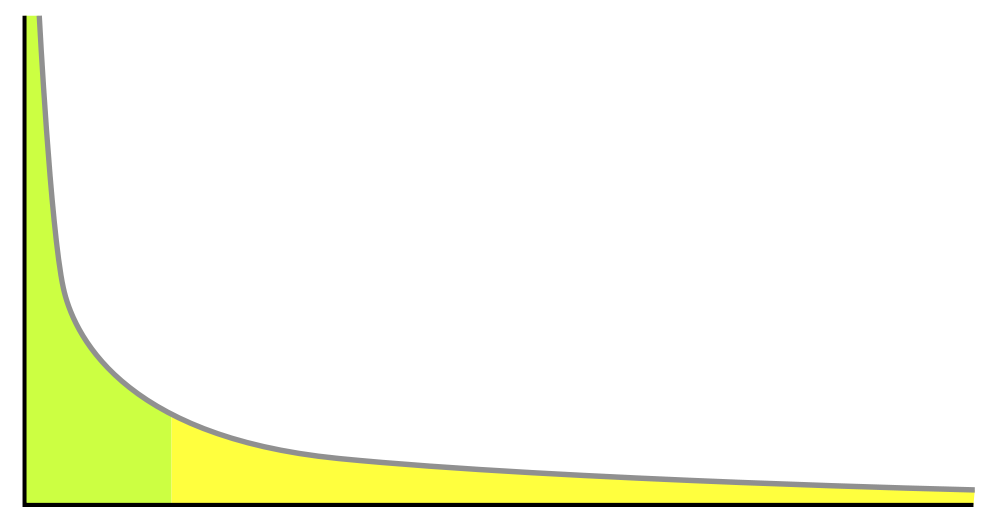
In statistics, there is a concept known as the long tail, relating to the distribution of certain events (fig 1)

Fig 1: A Long tail curve

(Source Wikipedia; “Long tail” by User:Husky – Own work. Licensed under Public Domain via Commons – https://commons.wikimedia.org/wiki/File:Long_tail.svg#/media/File:Long_tail.svg)

In our case, we could say that the Y axis represents public visibility and the number of practitioners on the X. As can be easily seen, a few practitioners are highly visible and could therefore be considered well known. The rest are all at about the same level. If we applied our Pareto concepts to this, the curves fit and 20% of the people have 80% of the visibility. Great news for them, not so for the rest of us.

How do we go about moving from the unseen to seen? By creating more awareness? This is where the noise problem kicks in. If we are all shouting louder to attract attention, the noise floor just raises, burying the wanted signal in the unwanted clutter. Noise is, as stated, any unwanted signal on a specific channel. Most people have fallen for the myth that communicating via social media is the way to go, to collect followers and post lots of fun things to them. However, time the posts wrongly, include things that people don’t want to hear and you become noise, another missed or irritating signal. So you can either get around this by turning the signal up, posting more often, collecting more followers, likes etc and hope it has the desired effect or you can change tack.

If we were to use a mobile comms approach, the shout louder approach is a 2G, old generation one. If you can’t get above the noise on your chosen frequency band, use a bigger amplifier. With more modern techniques, including wifi and 3/4G mobiles, we use a process known as spread spectrum. This takes the signal we want to transmit and spreads it out across the transmission medium, allowing it to avoid noise, jamming and requiring less overall transmission power. It requires sychnronisation between receiver and transmitter, a process that is handled and agreed at initial set up.

Applying this to a clinical field, if we want to communicate with our current or potential client base, we need to communicate over several different frequency bands, at a known rate and with information that is valid to them. For example there is no point having an active Facebook page if your clients are over 50, never use social media and are very local to you. Instead, we need to use the current base as hopping amplifiers, taking our signal and passing it on. This also allows us to use the trust generation, where one person implicitly trusts a connection, since their friend does. This can require both a driven and request based protocol, where we either ask the person to refer us or produce something that they will want to pass on, spreading our message.

How does all of this relate to the long tail? Without a well structured communication and client generation plan, we are within that tail, an issue also connecting to income. The 20% that might be getting the visibility may also be the ones getting the patients / income. In the creative industries, there are a couple of thinkers who talk about true fans. A true fan is one who buys all of the paintings a particular person makes, goes to see their shows, tells their friends and so forth. With a comparatively limited number of true fans, the artist can make a living, the number required varying with the art form (a musician may need far more than a painter as their average unit price would be lower). We too need fans, people who not only amplify our signal but who can provide us with some form of regular and steady income. Once you sit down and figure out how many you need, you can develop your strategy from there, so that your message is spread correctly, focused and not considered noise.

You don’t need to lift yourself up above the noise floor, just make sure your signal gets received by those who should see it.

Shoulder pain – Lat chain

If a patient is presenting with shoulder pain, once you have screened for red flags and visceral referral, we can focus on the mechanical presentations. 

Although we get taught hundreds of techniques for assessing shoulder range and function, in general a gross assessment of all planes will give you sufficient information to begin treatment. 

However, one area we tend to ignore or forget is the connections to the rest of the torso. 

We need to look at fascial chains connecting the anterior shoulder to the chest and abdominal structures and especially the role of the lattismus chain in the stabilisation of both the lumbar spine and the shoulder. 

Referring back to our core principles, we can see that if the pelvis and lumbar spine are dysfunctional then the lat chain and hence the shoulder may be recruited to improve stability. 

Therefore, whenever we see a shoulder issue, it falls on us to check further away which may lead to a more significant improvement than just working locally. 

Training made personal 

No matter how much you wish to make changes, sometimes the internal motivation simply isn’t there. 

Time pressures, knowledge, medical complications all make a difference in getting moving and making changes. 

In these circumstances, it’s a good plan to get a trainer in. 

The issue is how to pick one. 

A few pointers might be the following:

Do they look like they walk the talk?

Are they qualified and take regular courses to keep learning?

Are the regimes they’re recommending suitable for you?

Are they working from a big gym, a crossfit box or visiting home? Each has its own philosophy which you might love or hate. 

Can they give you references from successful clients who aren’t mates? 

Most will also give a trial session of two so you can experience their methodology. 

In the end, go by gut and get after it. 

Ask the right question

To get a useful answer, it is important to ask the right questions. 

    Rather than adding extra effort, look at what you can take away. 

    If you can only see 2 paths, look for a third. 

    If you’re trying something new, has anyone done something similar before? Even a different discipline offers guidelines.

    Does it actually need to be done?

    What one thing, done today, will have the most impact? 

    Can this be a yes or no, rather than a maybe? 

Try one next time you’re stuck and see if it helps break the restriction.

When the going gets tough;

Stop.

Breathe.

Think: Do I really need to be putting myself through this, is there a more efficient way?


If you’ve been banging your head against the same problem 42 times, perhaps the 43rd attempt won’t solve it either.

If its a workout, or a programmed training session, then dig in buttercup, the outcome is worth the effort. The same if its a challenging work scenario with a defined goal.

But if the task has no defined goal, no finishing line and seems apparently insoluble, then perhaps you need to take a break and reflect.

It could be that someone has been down that route before and talking to experts could save you hours of time.

It could be that “we’ve always done it that way” isn’t actually the best anymore.

And it could be that, however good your intentions, the goal isn’t going to fit your long term plan.

Stop, breathe, think.

Then get going again.


Out there

Out there is your dream job.

It isn’t.

Out there is your perfect partner.

They aren’t.

Out there is your perfect body, if you just take this supplement and do this five-minute exercise.

Nope.

Out there is a realm of possibilities.

Wrong.

Out there is a fantasy place, a modern dream  to placate the meek, invented to sell the next quick fix or short cut “hack”.

A sheen of glamour to disguise the truth.

Reality says there is no such thing as a dream job. There is the something that you are well suited to doing, where your unique talents and skills can be applied. It may take you years and several false starts to get there, and it will require hard work, self-discipline and flexibility.

Reality says that there is no such thing as a perfect partner, the soul mate who will happen to walk around the corner and into your life. There may be someone who is supportive, loving and with whom you click. They may be with you for years, or for a short time. And maintaining a relationship takes hard work, self-discipline and flexibility.

Reality says there is no such thing as a perfect body. Just the one you have been given. We can change it, support it and develop it to its best potential but you may never be a size 8 if your skeleton says otherwise, you may not have Rich Froning’s abs is you don’t have his genetics. And any change takes hard work, self-discipline and flexibility.

Right now is a realm of fantastic possibilities. Dreams can become ideas can become plans can become reality.

And out there is a whole team of people, be they friends, professionals and expert sources who are willing to help you achieve.

But it all requires hard work, self-discipline and flexibility.

One way or the other

Momentum – the force that allows something to continue or to grow as time passes. 

Inertia – the tendency to remain the same. 

Starting something is tough. There is always a reason not to do it, a task that’s more important, an article that needs to be read. 

In physics, we have the concepts of inertia and momentum, as defined above (roughly). These apply everywhere in life, from starting the car to changing a habit. 

Starting takes energy and consistency, you need to give the job attention and drive. 

But once it’s rolling, it takes far less to keep going. 

So, put some energy into your big goals and watch them become easier to achieve. 

And, if you need professional advice or support, ask. 

Big Rocks

We all know that exercise is important, that is is the best medicine.

But there’s never enough time.

It takes too long to drive to the gym, change, follow the program card, shower, drive home.

So many of us aim to do it like that, its what the experts and celebrity magazines tell us we need to do.

The experts. The people who own gyms. The fake celebs with too much time on their sponsored wrist watches.

The people who make money from our seldom used good intention memberships.

These people would prefer it if we ignored the less commercial solutions.

There are, of course, many benefits to a well set up gym. Resistance work has been shown to be hugely effective at preventing a wide range of medical issues as we age. They can be sensible for many people, both from a medical and a personal safety perspective (not everyone feels happy walking or running around the darker areas of town). Training with a group or a qualified coach can be far more motivating than on your own.

And sometimes the best gym is your front room, a kettlebell and mat. A brisk walk, a few swings, a few squats, a bit of stretching, 30 minutes. Current advice shows huge benefits are gained from only 30 minutes a day of moderate activity. A 30 minute morning walk, with a few stretches after.

No machines, no noisy sound systems, no strutting peacocks.

Your music, or silence. Privacy, so no body anxiety. No travelling. And a free shower after.

Whatever your exercise style, make it a big rock, something that is really important to you, and figure out how to put it in the bucket first.

Even if that means a 5am alarm.

Its a better start to the day that pretty much anything else.


Simple is not the same as easy.

Losing weight is simple. Burn more energy than you consume.

Getting fitter is simple. Train smart as well as harder. 

Being richer is simple. Earn more, spend less.

But is never seems to work like that. It is the details that hold us back. Losing weight generally means losing bodyfat, and the techniques required for that depend on your starting point. Getting fitter is similar. Starting from zero, anything is an improvement, but the closer we get to the goal, the more the process has to be refined. 

And, the further we go into the weeds to find the shortcuts, the more complex it all seems to become. We can get snowed under in the details, the little things that seem to become important in the eyes of a self proclaimed expert.

Keep in mind, the simple things. Fuel well, drink water, move more. And if you get lost or stuck, come back to those.

As for getting rich? Find something you enjoy doing most of the time (no one loves their job every day) study hard, try to find a balance between work and play, and don’t spend as much as you bring in. Good luck!