A useful tool for client profiles

Every day, we take clinical histories of patients and basic medical backgrounds.

Very often, we also do basic biomedical testing – height, weight and blood pressure, to give a brief picture of any issues that need to be addressed immediately.

To allow me the simplicity of calculating the clients Body Mass Index, Guideline Basal Metabolic Rate and Bodyfat percentage, I created an excel spreadsheet.

It also outputs a number of other trackable variables so you get the best bang for your buck!

This is attached here: Formula Tool

It allows for age, and sex as well, so might provide a useful reference guide.

Get the basics right first 

It doesn’t matter what supplements you take, what your morning ritual looks like, who your guru is or whether you prefer goji berries, blueberries or beetroot as your preferred superfood, if you’re not getting stronger, faster or any achieving any measure you’re aiming for, there’s something not working. 

Nothing happens without enough sleep, enough water, enough high quality macronutrients. If you don’t get the basics sorted first, you’re building your castle on sand. 

So before you start spending on the latest expensive magic product, check you’re getting:

7- 8 hours restful sleep

2-3L water / fluids

75-150g protein

Plenty of vegetables and berries

No? 

Figure those out then move forwards. Basic consistent steps climb mountains. 

Be Ready….

If you can run 10k in 40 minutes but not carry your buddy 200 yards, are you ready?

If you can squat twice your bodyweight but can’t even run for a bus, are you ready?

If you can walk for hours with a pack but can’t climb a rope, are you ready?

If you can’t swim 25m in a pool, clothed, are you ready?

You never know what life will throw at you. It may be carrying a sick child home from a day out, helping a friend move house, walking across town because the traffic is messed up, or even being caught up in a situation where your skills and fitness are vital to keep yourself, and those you’re responsible for, safe.

Chris Hadfield, in his book “An Astronauts Guide to life on Earth” has a point about being a zero.  You might not be a direct asset to the situation at hand, but you really don’t want to be a burden. Being fit and ready to respond makes you a better zero.

We all like to think we’re fit, but have no idea what that actually means. Being able to run 10k fast is a skill but if you’re washed out for a week after, that isn’t so great. Being built like a rugby prop is useful, if you play rugby. But those guys and girls can also run very fast (at least the professionals), can you?

For its many detractors and weaknesses (not enough endurance based cardio respiratory training in most boxes), crossfit and its like offers a great way of being a better human. Not only do you get faster, fitter and stronger, you can develop mobility and recovery.

Of course, you don’t need to join an expensive box to improve. A few basic kettlebells, sandbag and jump rope are all you need to start.

And get some first aid training. The basics really are basic but could save your life and those who you love.

So be a better human and a positive asset to everyone around you. Get after it.

Linked below is a basic training plan and ready guide. It assumes you can move without pain but little else. Caveat: See a medical professional before starting any new form of exercise plan to make sure it isn’t going to kill you.

Be Ready V2

Listen to your gut

Too often you’ve heard the phrase “You are what you eat”. But have you considered the effect of what you eat on your performance, mentally and physically?

We all know caffeine can give you a pre workout boost, carbohydrate drinks are sometimes necessary for energy during a long session and a good recovery meal helps you prepare for the next one. We also know that some people suffer from significant allergies and intolerances that have a huge impact on their lives.

But what if what you were consuming was having a negative effect on you? Not catastrophically but in little ways. That the bread roll with your soup at dinner had triggered a little bit of gut irritation which reduced your capacity to perform through mediated inflammation? That a spot of reflux and indigestion from eating too late and too much had stiffened up your thoracic spine, leading to an inability to squat as efficiently?That the beer to celebrate a good result had set off a minor chain reaction leading to a niggling injury due to reduced healing capacity? That the fructose in your sports drink started a series of cravings for other sugary treats later in the day?

All of these are not uncommon cases of tiny adverse reactions to food and drink, but we too often ignore them. Thats not to say that we need to be utterly soulless and controlling about our diets, simply aware that what we put in has a dynamic and often medium term effect on our ability to perform optimally.

Pay a little more attention to the effect of what you consume and reap the rewards long term.

Story, Focus, Drive.

Ever worn prismatic glasses? Often found at science fairs, these  creations appear to turn the world upside down. What they’re actually doing is putting it the right way up, since the lenses in our eyes invert everything and we have learned to correct automatically somewhere in our brains. Put on a pair and for a while, everything is difficult to do, your hands miss whatever you reach for and it’s impossible to walk. However,the brain very quickly learns the corrective states and you are able to get on as normal. Take them off, and the whole sequence has to be unlearned, which interestingly seems to take far longer.

This little trick confused natural philosophers, even Isaac Newton, for centuries as they knew from camera obscuras that lenses can invert images. So, as well demonstrating a number of fascinating facts about the brain,  it can be used as a metaphor for learning and achievement.

Some things we instinctively do. The basics of humanity are simply picked up as we go along. Walking, eating, sleeping and talking come pretty much built into the hardware. Other skills are taught in a more formal setting, such as reading, writing and mathematics. These require a structured approach but can be applied as a base layer of education to everything else we need to do. Beyond that are the skills that require time, effort and talent to achieve a high level of competence. None of us will be Usain Bolt, Chris Hadfield or Caitlin Moran. These people not only have brilliant born talents but have worked very hard to get to where they are.

The common ties between these layers of skill, innate, basic taught and advanced, other than practice are:

Story

Focus

Drive

A child wants to walk to explore its surroundings. Reading, writing and mathematics allow us to gain some traction in understanding the world better. Usain Bolt wanted to be the fastest runner, Chris Hadfield wanted to be an astronaut, Caitlin Moran a writer. From those basic goals, everything else flowed.

Refine, polish and adapt your story. Use that to generate the focus and drive that will get you many steps closer to where you need to be than just wishful thinking. If you don’t seem to be getting progress, review the story. Sometimes side branches can become the main path, occasionally they’re dead ends.

And looking at the prismatic glasses? Put on a pair and the brain suddenly has to get back to a state of normality, so will figure out the way to go about that, even without your slow conscious input. Your story can be the prismatic glasses. Why not give them a polish?


Context!

Everything needs to be seen within the correct context.

stone crop 2

Unless you know English landscape history fairly well, this is just a man standing next to a rock. And even if you did, you couldn’t be certain what you were looking at.

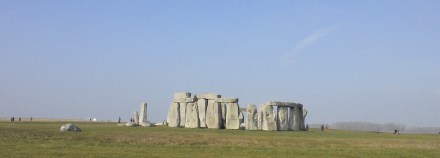
If we zoom out and look at a larger scale, is becomes this:

complete stone

Stonehenge 2016, Copyright T. Saltmarsh


But even then, this is not fully seen within the true context of its historical environment, with the additional burial barrows, the ditches and the surrounding landscape, mythological and physical.

The same comes when we are treating or working with clients, whether elite athletes or older people.

If we cannot see the bigger picture, or insist on just treating the problem they presented with, we will not be able to solve the problem effectively. A knee sprain may not heal if we don’t work with the coaching  staff to ensure the athlete gets corrective exercise prescription or time off lower limb loading. An older patient may not regain full range of motion if they are afraid of falling and therefore do not attempt the mobility plan you recommend. A desk bound client will still have the recurrent shoulder problems if they don’t tell you the whole story about the work and family related stress, or at least acknowledge to themselves that it exists.

So don’t just look at the rock, block or restriction, zoom out and take into consideration the environment it exists in.


Focus on the now

Buddists and other meditators claim that there is no past, no future, only now. Yet we spend most of our time ignoring whats in front of us and instead thinking about what has been or what might be, not being in our heads and focusing on the immediate task. This is not to say that planning (an almost unique skill in humans) is not vital, as otherwise we would be wasting ourselves spinning in circles watching a small screen, but this long term plan has to be combined with appropriate action now.

From a movement perspective, when coaching clients in new patterns, I use 2 key words  as triggers. Attention and Intention. What is the attention on and what is the intention. For example, moving the shoulder joint, the attention is on the joint, the way it feels and glides, while the intention is that the arm should move slowly and under control at all times. Many find this very hard to do as the mind tends to rebel against focusing on just one thing. The same is with running, the attention cannot be on the whole activity, as  we cannot cope with such input, but instead on just feeling the push off, or the chest postion, or another skill.

A five minute challenge, when moving next time, ask yourself: Where is my attention? What is my intention? Not just in a movement pattern but when working as well, it may provide some interesting results.

The only person to compare yourself to. 

Not the guy in the next squat rack, not the girl on the yoga mat who can tie herself in knots and always looks perfect, not the professional on the tv. The only person to compare yourself to is….

You. 

Are you a little bit better than you were yesterday? 

Age inevitably degrades our performance slightly over time, with some researchers considering the average value to be 10% per decade, but most of us haven’t achieved our true potential in any decade so there is no reason why most of us cannot at the very least maintain results with improved efficiency and technical skill. 

Rather than using any comparison as an excuse, figure out what you need to do to be 1% better. Harder work is not always the answer, instead see if you need to get out of your own way by working on mobility, becoming more efficient or focusing on a specific movement. 

Gym free workout of the day

Got 10 minutes? Want to change your life for the better? High intensity short interval work has been shown to be highly effective. Try the following:

  • 2 minutes seated wheel breathing 
  • Then complete as many rounds as possible in 5 minutes of: 5 burpees / 3 inch worm pressups
  • 3 mins wheel breathing

Guidelines 

Wheel breathing– sitting comfortably, focus on your breathing. Allow each inhalation to be followed, smoothly and slowly by each exhalation. Picture yourself successfully going through the workout efficiently, effectively and relaxed. Afterwards, just focus on letting each breath flush all the stress and fatigue from your body, so you’re ready to face the day. 

Burpees– start standing straight, squat down hands on the ground, thrust feet backwards to press-up position, pressup, reverse to stand with a jump out of the squat. 

Inchworm pressups– start standing up, bend forward to touch toes, walk hands out until you are in the pressup position, lower down, hands off the ground into a back extension, reverse to get back up. 

Scaling versions

Burpees- 1 burpees is 3 air squats jumps. Squat down, knees behind toes, then spring back up to jump as high as possible. 

Inchworms- kneeling pushups with back extension. Kneel down, lower yourself smoothly, hands off and extend the back, then push back up again. 

Whichever version you do, try to keep going for the whole 5 minutes.

Semper Pergendum!  

The Camford Clinic. Professional osteopathic sports injury and life management in Alton, Hampshire. 

01420 544408

Info@the-Camford-clinic.co.uk

Can’t does not exist

Not only is it a contraction of cannot, it is a word that disempowers us all. You cannot do that, I cannot do this. These phrases mentally weaken us by throwing up barriers that restrict our perspective.

Instead, reframe the statement. From I cannot, move to what is stopping me? With almost every goal and outcome, there are obstructions, whether physical, social or psychological. Some of these are with good reason and purpose (you cannot jump off the top of the london eye, for example), but for almost everything else, with a change in the way the statement is created, a path and a way forward can be discerned. From identifying what you want to achieve, it is possible to understand the knowledge you need to gain, the skills that can be learned and so step by step, move closer to where you wish to be.

We can get better, because we’re not dead yet.

Frank Turner Get Better


One foot in front of the other 

The oft quoted line is “A journey of a thousand miles starts with a single step”

What’s conveniently ignored is the subsequent steps. The ones up hills, through blizzards, rain and so forth. Inevitably our mythical mystic would have encountered these but they are brushed under the metaphorical mat unless pertinent to the retelling. 

A better narrative might be the one that admits such adversities and encourages progress and learning in spite or through the challenges. 

The trick is to maintain momentum, use easy moments to help carry over the harder ones and to accept that all things must change, all things have an end. 

In a running race, use the down and flat to recover, in a lifting competition, tactics, in the pool, don’t fight the water when tired and in life, take delight in the simple pleasures before the fading light. 

Semper Pergendum Sine Timore

Forward without fear!