On being a god

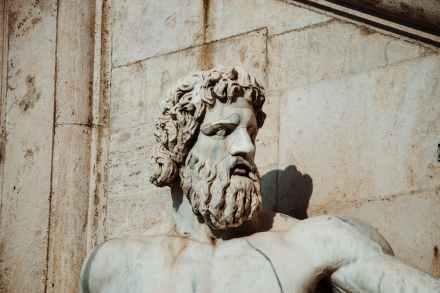
So you want the body of a god. Pick your pantheon. Greek, Roman, Norse. All images are interpreted by artists and storytellers, so what you’re actually wanting is the body that a painter, sculpter or mosaicist created to symbolise their desires. I wanted the body of a god and got Dionysis.

Anyway, god, or goddess, it is.

First, to be like a god, live like one. Perhaps without the destruction and disinterest in the humans, but in other ways, train, sleep, eat like a goddess.

The norse gods would have had fish, grains, meat, washing it down with beer (mead is for celebrations). The greek or romans? Fresh fish, fruits and vegetables, olives, breads, cheeses. What you put in, is what you get out and eventually the body composition will follow the diet.

The one thing none of the diets would had would have been confectionary (other than sweet cakes, ambrosia and dried fruits), and processed foods.

As for training, for the greeks, lots of running, throwing, lifting (think olympic disciplines). The norse, heavier lifts, walking, hunting and rowing. They created their gods from what they knew.

To be like a god, first live like one.

What has any of this got to do with a sports injury clinic?

Firstly, I firmly believe that we forget the basics to follow the latest trend or fad. Secondly, we are what we consume. Thirdly, even the gods needed help and support sometimes and having an expert at your side when you go on the journey is a good thing.

We can offer nutritional reviews, training and planning support and treatment for those injuries sustained in the cause of achieving your goals.
On: Finding the one thing

Sometimes it takes only one thing to start the rock rolling, the pebble that is stopping the landslide of success.

Sometimes, once you find that one thing, everything else falls into place and it becomes brighter, easier, smoother.

However, finding that one thing is very difficult, as it is different for person, goal, and phase of life.

And sometimes, it doesn’t matter what the thing is, as starting anything can help.

Maybe you want to lose weight for health reasons (there aren’t really any other valid ones). Maybe you feel you need to improve your fitness (there could be a couple of reasons here), perhaps you feel stuck in a relationship (a multitude of reasons in there), or you’re at a fork in the road with regards to career.

Lets take health (we are a health organisation after all) and weight management. There is ostensibly a simple recipe for this. You want to lose weight, burn more calories than you consume, you want to gain wait, eat more. Now, lets take into consideration motivation, working and life paatterns, underlying health status, stress, prior exercise history, gender, nutritional history and current nutritional status and see how we go? Which one thing is going to unlock the magic box of slimmer?

For most people wanting to lose weight, it will simply being aware of what they eat and when. That awareness helps them tune their consumption. For others, who have a reasonably good grasp on it, moving a bit more frequently and with higher intensity could be the key. A more complex case might be the older person with underlying health conditions, who will need more close monitoring, motivation and coaching to ensure they maintain both good nutrition and reduced risk.

To find your one thing, contact us for a consultation. We don’t just do manual therapies, we support weight management journeys, fitness plans, proactive healthcare discussions and personal accountability coaching.

Doom loop

Dieting will not work long term.

You will not sustainably lose weight until you address the factors that made you fat in the first place. You may shed some timber for a specific event, or a short period, but it will not stay off and you are likely to get heavier if you don’t address the underlying factors.

Whats going on?

You are, in some way, a victim of the doom loop. You almost certainly weren’t born fat. You probably weren’t fat as a child, and then at some point you started to gain weight.

Lets start with a period of stress and inactivity. Perhaps exams, psychological issues, peer pressure and bullying at school, a family crisis, an illness leading to hospitalisation, or at least a time of recuperation. The inactivity is the important bit. This initial phase can be coupled with increased caloric intake for comfort eating / poor nutritional availability and so forth.

For most people, especially if there was a period of bed rest, some muscle mass is lost, or at least a significant reduction in exertion, as well as some fitness. This leads to a reduced caloric requirement as well as a shift in the endocrine (hormone) status. However, most people don’t account for this (and why would you, you’ve got other things on your mind), so gain a little bit of weight.

Not much, but just enough that, in combination with the loss of fitness, it adds up and the return to activity is hard work.

For most of us, the generally fit and healthy adults, especially if you’ve been reguarly active, we suck it up and get back on with it, the weight gain goes again and we break out of the issue.

However, far too many unconsiously remain inactive, or keep being kicked around the loop.

And, having seen the weight going up, the dress not fitting quite as well and generally not feeling quite so good about it all, we often attempt to correct course, either through exercise or through caloric restriction.

However. Both of these, and especially dieting is stressful. Cortisol increases, changing the way our body burns fuel, and for some of us, reducing the amount of energy the muscles use (probably an evolutionary throwback, since you are essentially inducing a famine state in the body by eating less so burning less is a good survival strategy). As we said ealier, you can lose weight short term but eventually the body will replenish the stores and it’ll all go back on again.

Now we’re into the doom loop. We are trapped in a cycle of stress / weight loss / weight gain / inactivity.

How to break out of it?

Don’t diet. Don’t even cut back on calories. To start with, don’t really go for it and hit the gym.

Your body needs to move regularly and have less stress to deal with.

And even if you can’t get rid of the external stress because the world is going crazy and the bills are stacking up and the dog next door like barking at the moon, then you can control the internal stress.

Drink less alcohol. Stop smoking. Go to bed for 8 to 10 hours. Turn off the social media firehose and stop scrolling netflix at 1am.

Then move. Just 5 minute movement snacks. You don’t even need to break a sweat, Non exercise related activity is how we should spend most of our lives.

On: Tendons and Ligaments

Tendons tether muscle, ligaments link bone.

But both can be damaged, become weakened, or scarred.

So how can we, both as practitioners and people, prevent this, or at least minimise its impact?

Prevention is always better than a cure, and therefore ensuring the tendons (when reading tendons, assume ligaments as well, although there are differences in all sorts of subtle ways) remain strong is vital.

Note – If you are currently taking medications, especially certain antibiotics, check with the pharmacy regarding soft tissue effects. For example, Fluoroquinolone antibiotics have a rare side effect with regards to soft tissue, so if you are prescribed those, it may be sensible to reduce training load during and after the treatment.

Tendons can be trained, like any other tissue, and research indicates that they respond best to cycles of isometric tension, of approx 10 – 30 seconds, with 30 – 50 seconds rest. Initially, it doesn’t even matter what joint position you are in, as long as the tendon is under tension, and pain free. Over time, you can increase the load and the number of cycles you carry out, to ensure continued development.

There is also some evidence that longditudinal supplementation with collagen (preferably from biologically similar connective tissue) is beneficial, especially when consumed with vitamin C.

Once you have a stable, platform, you can work on repairing any scarring or weaknesses in the tissue by using long duration concentric / isometric / eccentric training movements, through the pain free range of motion. For example, a squat under light load, with all three phases taking 10 seconds, although this time is individual.

Finally, there is also some evidence that early, and safe return to loading after injury can help reduce the time to competition, since the stimulus causes the scar tissue to form beneficially, rather than scattered.

TLDR: tendons can be strengthed, healthy tendons can increase your overall performance, isometric exercises are beneficial to tendon health.

On: Obesity

We all know what obesity looks like. Too many ‘spoons pie and pint nights, too many burgers, not enough gym time.

Except, we don’t.

It might be visually obvious if the T shirt barely covers the waistline, but how do you define it? If you use the BMI scale (weight in kilos divided by height in metres squared), then obesity is considered anything over a BMI of 30, overweight is over 25, healthy is 20-25 and so forth.

But then a lot of athletes, especially power althletes, are obese. Of course, the more mass you have to move around, the greater the load your body has to manage, both for joint health and cardiovascular load but this doesn’t take into consideration the positive effect of muscle mass, cardiovascular fitness, and any other number of markers for health. The only use for BMI in most aspects is to tell you what you already know, when its far too low or far too high. For reference, you probably don’t want to be below 20 (not enough muscle mass) and above 30 (increased risk of joint issues).

A preferred methodology, for a rapid ready reckoner, is height to waist ratio. This ignores mass, but can idicate central obesity, which has been shown to have a detrimental effect on internal organs and general health. This is simply calculated as a ratio of height to waist circumference (waist divided by height in m), and should be less than 0.5.

As for markers of fitness, define your own. Markers such as the amount you can lift, or how fast you can run, are spurious goal setting. And no matter what the companies might say, you can’t tell your fitness from blood tests. Those are for if you are sick. Otherwise the levels will constantly fluctuate and tell you very little.

Be able to run, if you have the physical capability. Then try to increase the distance you can cover. Lift heavy things safely, then do it again. Move regularly, as smoothly and freely as possible. Constantly develop your capacity.

Train as though your life depends on it.

It does.

On: You’re wrong about the gym

A new gym opens, the marketing tells you that if you join, you can finally tone up, lose weight and get fitter.

Possibly.

But only if you know what you’re doing with the rest of your life.

Otherwise, its just a kind of fun place to hang out and move.

The gym should be a place of education (in ancient Greece, the gynasium was a place of practical learning, and its still grammar school in Germany). It should be a place where you find new boundaries, develop skills and work on yourself. It should be a structured, functional representation of the rest of life.

But. If you were to get a modern gym goer to take off their huge headphones, stop posing for IG reels and ask them why they’re there, it will more likely be that they want to get toned, or lose weight. Or both. If you managed to ask a teen boy, they’ll probably tell you they want to build muscle. The ironic thing being that a healthy teen is so awash with growth potential, almost any resistance training will create that effect. Less so a man over 30 but the potential is still there.

None of those will happen unless you have the rest of your life squared away. If you’re too stressed, if you’re not sleeping great, if you leave the gym and walk straight into Costa for a triple syrup latte with added cake, if you don’t get your protein intake dialed in, if you don’t allow yourself space to rest, then its going to be so much harder to achieve any of your desired outcomes.

Even if you have defined them well enough. But thats a subject for another day.

Go to the gym. take advice from a professional, not just an influencer. but get the rest of your life sorted as well.

On: Fitness

A colleague had started going to the gym “to get fitter”. While admirable and absolutely to be celebrated, I did wonder how they would know when they had achieved that goal.

After some reflection, and a walk, I developed the thought that fitness can be broken down into 2 main components. A duration / distance one, and a strength / durability one.

Duration / distance is comparatively simple. Can the person go further, for longer, or faster. These are goals that can be defined, measured and checked. Walk for a mile, walk for an hour, finish a 5k event, run a marathon, cycle for 3 hours, push the wheelchair to the shops.

The other component is harder to measure. Yes, strength can be measured by increasing the amount you can move against resistance and for how long. But that doesn’t tend to serve an end purpose. I would posit that the role of strength for the vast majority of people, athletes included, is to help them carry out a defined task with more capacity, to be more durable and to recover faster. In Crossfit this may be to complete the prescribed workout faster, or with less fatigue. For others, it may be to be able to carry a child, lift down a suitcase or spend longer with their family before tiring. And for all, it should help reduce the risk of injury.

By redefining our initial goal of fitness, we can review the strength component in this capacity and then prescribe the correct stimulus to get the desired response.

Instead of saying you want to get fitter, define a goal, and a measurable, meaningful outcome. Then tune the exercise to that.

On: Galen

The history of medicine is littered with men, and women, who even today, have an impact on the way we treat and are treated when we are ill.

One of these, and one of my favourite, was Galen. A Greek physician who practiced in the 1st Century CE Roman Empire, he studied extensively before moving to Rome and eventually becoming physician to the Emperors, and Gladiators. This gave him significant insight into many areas, and although we now know that many of his thoughts on illess and physiology are incorrect, a great deal of his work is still relevant.

Two of his tenets, which I believe still stand, and we still use are:

The body is a complex interconnect system, which has the capacity to heal itself. This is very similar to the osteopathic principles.

Use physical therapies first, then drugs, then surgery.

This last principle is still undervalued by both patient and practitioner, as it is not an easy fix, and given today’s current phamacopea, it is too easy to reach into the cabinet and take a pill rather than look for an underlying cause.

I would advocate to choose to be different. Seek the cause, make a change and overall health will improve.

The big secret the fitness industry doesn’t want you to know.

They’re lying to you. They have been for years and maybe even they’re lying to themselves.

They’re selling you all these messages and machines and plans and regimes. And they’re not going to work, leaving you disappointed and looking for the next big secret. The next short cut.

So, what is the secret they don’t want you to know?

Exercise won’t make you lose weight. Diet won’t get you fitter.

All the booty classes and HIIT training and smoothies and shakes don’t work alone.

Maybe if you’re running 5-6 hours plus a week then yes. You may lose some weight. You are going to create a significant enough caloric deficit to see a difference. But not much and not for a sustained period. If you don’t back it up with a solid refuelling and recovery strategy.

You’ve got to do both, in the correct proportions.

Look at a visually super fit person, that influencer, gym bunny. Not only are they exercising frequently, they’re looking after their nutrition. They’re not completing the circuit class and immediately down the coffee shop for a syrupy latte. The inside is reflected on the outside.

Exercise is for fitness, nutrition is for weight management. The combination leads to improved health. Which is reflected in your physique.

You don’t need their latest method or protocol or supplement. It’s been said before but you don’t like it because it’s hard and slow and repetitive and dull.

  • Eat to sustain activity, refuel and recover.
  • Eat occasionally for pleasure.
  • Exercise to improve muscle mass
  • Exercise to improve cardiovascular health
  • Exercise to maintain balance and skill
  • Exercise because it’s fun
  • Do it regularly and seek healthcare advice when something seems wrong for a while.

Simple is not the same as easy. But consistency and iteration works.

Resilience and capacity

In the end you have to have something that I give to give the disease as a price of recovery.

Not sure where I heard that but it makes sense.

The more fitness, the more muscle you have to give a serious illness, the more likely you are to come out the other side.

Professor Oliver (geriatrics) noted that he could guess someone’s probability of a safe discharge from the quality of their handshake. Firm, strong, reassuring. Weak, flaccid, concerning. A handshake conveys vitality, determination, strength, even psychological state.

Put the work in now so your future self can live to fight another day.