5 daily habits, 3 basic skills

There are 5 habits we do every day, and that most of us take for granted. They are the basic skills needed to function well in everyday life, well before the more complex elements of household management and navigation in a modern society come in to play.

Yet when we are unable or unwilling to perform them, it’s time to ask for help from those around us, as they are the foundation stones on which all other skills rest. These are the things that our primary carers would have taught us to do by the time we were ready to leave home and almost all of us will have done today.

  1. Get up and make your bed
  2. Perform a personal hygiene routine and dress appropriately
  3. Prepare and eat a nutritious hot meal
  4. Movement and physical maintenance
  5. Interact socially and do something creative and productive

These can be viewed as a stack, and performing one allows the next to take place more efficiently. The inclusion of creation and productivity in the list, is in my mind, crucial, as it allows us to express an important element of our personality, and its presence or absence is an indicator in our mental, as well as physical health.

The habit most people will tend to misunderstand and misinterpret is that of movement and physical maintenance. Here, there are 3 basic skills that we should be able to perform unless we have a diagnosed impairment. And, as above, the inability to do these indicates that we need to check in with an appropriate professional for support and to allow us to regain them, or plan to mitigate the risk of losing that element of independence. 

  1. Get off the floor from lying on your front
  2. Get off the floor from lying on your back
  3. Walk a mile with a moderately heavy load

These use all the primal movements (push / pull / flex / twist / squat / lunge / walk), as well as the fundamental human expression of gait.

Physical maintenance is the skill of daily self care, being able to mobilise and strengthen the body, with stretching, joint position awareness, breathing exercises and strength training. If starting this practice, after a period of relative immobility, then it is recommended that you start gently, focusing on the ankles, hips and shoulder girdle, with breathing as a guide.
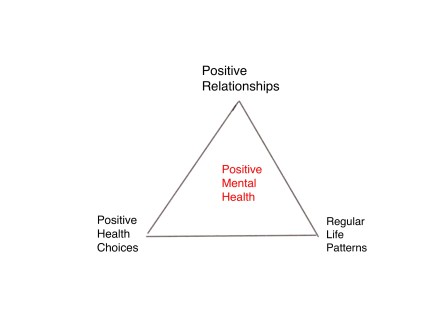
The basics of positive mental health

Firstly, if you reached this via a random search on the internet and are feeling stuck, buried under unmanageable pressure, in a corner or suicidal, breathe.

If that is you now, if you have a plan, if you’re looking for ways to end your life, if it’s so dark that the relief of knowing how is a comfort, stop. Please. Call a mate, phone Samaritans, if you think you’re going to OD or have, get yourself to A&E.

If you need to self harm to relieve the pain, to give you something to focus on, try ice cubes. Squeeze them in your hand and feel the burning cold. Put down the sharp blade and open a window.

When we, as professionals, talk to people who’ve cut or attempted suicide after we’ve stabilised them, they almost all regret it. Most attempts are a cry for help, to get attention, to put down the enormous burden, to ask someone to take over, just for a while, to deal with the crap life has handed you.

If this is you, I’m sorry. I have no idea what demons you’re fighting but I do know that so many have been there before you and there is a solution, somehow. But the never ending darkness is not it. There are charities who are there to support you, pathways in place to show you that, however dark it is now, there is a way forward.

Please note that this is not about mental illness. This is not about PD, psychosis, mania or depression. These are the kind that leaves you debilitated and requiring professional assistance. For those who have such things, it is important that the rest of us do not stigmatise them, help support them in any way and be conscious that we are all a few steps and some genes away from their situation.

For the rest of us, who live every day with our own mental health, it is thankfully starting to become more commonly talked about in recent years. The typical English attitude of stiff upper lip and crack on is slowly becoming more less expected, but the underlying causes of poor mental health is less commonly discussed.

Positive mental health is much more of a holistic approach, a way of recognising that body and mind are inextricably linked, that we can influence those around us and by intercepting negative trends, and that we may be able to prevent or minimise darker times.

The sketch above shows the basic pyramid of mental health.

Positive health choices are obvious in retrospect. Avoiding drugs that effect mental state (alcohol, cannabis, tobacco, illicit chemicals), taking regular exercise, maintaining a healthy weight, getting sufficient rest.

Regular life patterns play a more subtle role. We all have a circadian clock, a biological rhythm that governs eating, sleeping, and even more complex processes. But we also have a human need for regularity. For work, for seeing friends, for doing things we enjoy. If we neglect this, or it is removed from us, we soon notice its absence.

Positive relationships make more sense. We have all had relationships that drag us down, that make us feel less than we like to be. These can be personal, romantic or work, but their effect is pernicious and corrosive.

We can tolerate shifts in any one of the points for a period of time, for example poor health choices by eating too much, drinking too much or not resting enough, but if we also have a few unsupportive or negative relationships and no regular life pattern then we are in a slippery slope to poor mental health.

Mental health is a gift to be nurtured, shared and to be grateful for.

3 things

All you need to do to make progress is 3 things. 

Do it consistently and you will make huge progress. 

What those three things are depends on what your goal is and where you are. 

Want to make progress on a project? Do three things off your list. Some will be time orientated, some not. 

Want to improve your health? Eat, move, rest. 

And if you can consistently do 3, make it 5. But make sure you do them all before the end of the day. 

The trick works because it helps break inertia and provides momentum, mentally and physically.

Just three things, for each thing you wish to achieve. 

This even works if you’re  suffering with depression or other mental health issues. 

Focus on just doing three things. 

A personal care item (shower,clean teeth, shave), a healthy meal, a walk. 

Then, no matter how the rest of the day goes, you’ve done 3 positive things.